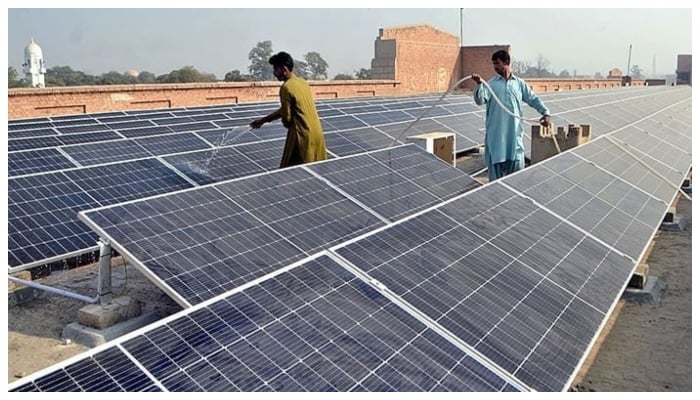
Pakistan’s new solar policy replaces free sunlight with expensive fuel imports – furnace oil, RLNG and coal. Just 2 GW of ‘missing’ rooftop solar adds nearly Rs50 billion (about $200 million) a year to the import bill. Policy that taxes sunlight does not conserve energy; it imports inflation.
Pakistan’s new solar policy creates a punitive buy-sell spread that kills investment. Imagine, the grid buys solar at Rs11 per unit ($0.04 per kWh) and the grid sells power back at Rs50 per unit ($0.20 per kWh). That 350-400 per cent spread is not price discovery — it is implicit taxation on clean generation.
Question: What is about to happen? Answer: Pakistan’s new solar policy will shift capital to batteries and diesel backup instead of generation.Red alert: The economy will be paying four to five times more per unit for the same electricity — while importing fuel and taxing sunlight. Annual economic loss: Rs136 billion ($500 million).
Pakistan’s new solar policy protects IPP contracts while penalising efficiency. Imagine, the least flexible cost (IPPs) is protected; the most efficient response (solar) is punished. That may save the grid’s cash flow — but raises the economy’s cost base. Annual economic loss: Rs91 billion.
Pakistan’s new solar policy raises policy risk and pushes investment off-grid. This would have three responses. One: Wealthier users go semi-off-grid with batteries. Two: Middle-class users absorb higher costs. Three: Productive sectors face higher power risk. This fragments the system and raises the long-run cost of power for everyone. Battery capex: Rs22 billion a year.
Red alert: Pakistan’s new solar policy imposes an annual economic loss of roughly Rs250 billion 00 nearly $900 million a year.
Worse, as rooftop solar is suppressed, capacity payments to IPPs are spread over fewer grid units, mechanically raising per-unit costs. This is not stabilisation; it is a slow-motion utility death spiral.
Pakistan’s new solar policy does not fix the power sector. It fixes contracts. The bill — Rs250 billion a year — will be paid by households, industry and the balance of payments.
The writer is an Islamabad-based columnist.