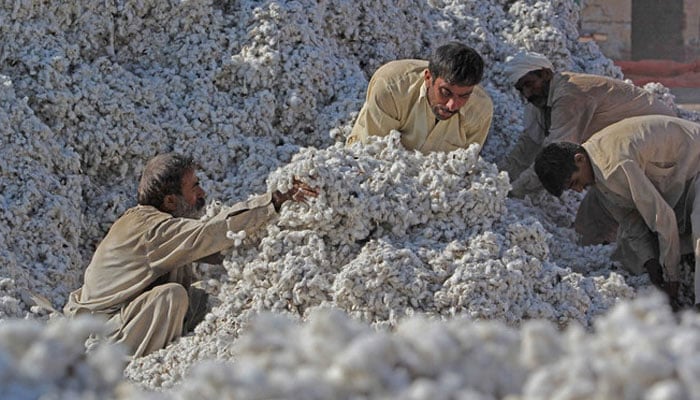
LAHORE: The national cotton arrival at ginning stage stagnates at 5.497 million bales, representing a negligible real-term increase of just 0.007 million bales or 0.13 per cent in the ongoing 2025-26 season till January 15, 2026 compared to the 5.490 million bales recorded last year.
While the total volume fails to show any tangible growth, a deeper analysis of sowing data reveals a staggering yield gap that points to a systemic crisis in Punjab’s agricultural efficiency, which pulls national output downwards. Despite Punjab sowing cotton on a vast 1.266 million hectares — more than double Sindh’s 0.562 million hectares — it produced only 2.586 million bales compared to Sindh’s 2.911 million bales, according to provincial Crop Reporting Service.
This means Sindh is producing roughly 5.18 bales per hectare, while Punjab languishes at a mere 2.04 bales per hectare; essentially, Sindh is achieving more than 2.5 times the productivity of Punjab per unit of land.
Contrary to claims that Punjab’s cotton is merely being transported to Sindh for ginning, historical official production data for Punjab confirms a sharp decline in average yield from 1,722 kg per hectare in 2023-24 to 1,413 kg per hectare in 2024-25, a real-term massive drop of 309 kg or 17.94 percent.
Crucially, seed cotton price trends too debunk the myth of Punjab’s cotton migrating to Sindh. Average seed cotton prices in Punjab districts like Rahim Yar Khan (Rs7,493/40kg) and Bahawalpur (Rs7,435/40kg) are significantly higher than Sindh’s Sanghar (Rs7,097/40kg) or Mirpur Khas (Rs7,073/40kg) during the 2025-2026 season, according to official data.
These higher local prices, combined with the logistical cost and difficulty of transporting bulky seed cotton over long distance, make it economically irrational for Punjab’s farmers or middlemen to sell produce in Sindh. Hence, it is insanely illogical that cotton is being shifted to Sindh ginning factories from Punjab and that too for fetching lower prices.
Experts believe that flawed cotton production technology, mismanagement on the part of provincial agriculture department and climate change characterised by erratic rain and extreme heat has wreaked havoc with the cotton crop in the Punjab province. Farmers in the province failed to apply greater necessary inputs as they have to sell crop on very low margin.
One of the fundamental factors reducing yield of many Punjab crops has been dependence on average quality groundwater unlike Sindh where crops are almost entirely irrigated with nutrient-rich canal water. This hard fact, often ignored by the Punjab policymakers, tends to negatively impact crop yield in the province as compared to Sindh.
In addition to competition from competing water-guzzling sugarcane crop, constantly changing weather pattern is one of the biggest threats to Punjab cotton in recent time, especially in the last two years. However, no attention is being diverted in this direction by the policymakers, particularly for introducing climate smart seeds and production technologies. Sindh’s weather pattern greatly suits cotton plants.
Untimely rains and extremely high mercury level hit cotton crop early this season. However, better-than-average winter weather — characterised by more brighter days and lesser cold from early December 2025 — triggered accelerated boll maturity and relatively boosted late arrivals, getting about 75,000 more bales in the last two fortnights than corresponding period of last year. Otherwise, cotton production could be lower than last year in real term. Nevertheless, it has not been enough to mask a deepening crisis of overall lower output.