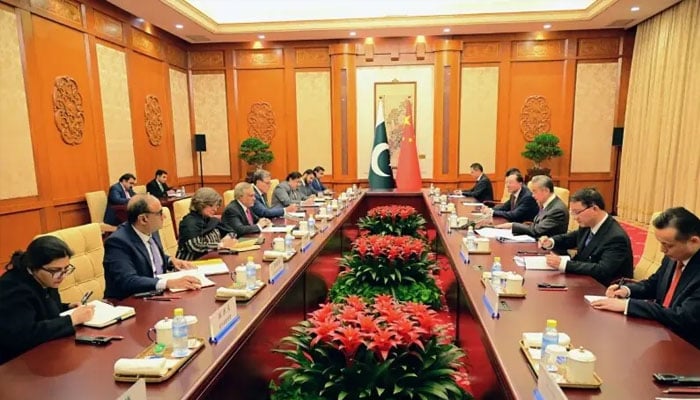
ISLAMABAD: Pakistan and China, while demanding more ‘visible and verifiable’ actions to dismantle and eliminate all terrorist organizations based in Afghanistan, also called on the international community to strengthen counter-terrorism cooperation, while expressing their firm opposition to double standards on counter-terrorism, says the joint communique issued after the Foreign Ministers Strategic Dialogue in Beijing.
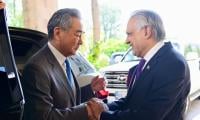
Counter-terrorism was a key issue during the deliberations between Foreign Minister Mohammad Ishaq Dar and his counterpart Wang Yi with China agreeing that Pakistan in firmly combating terrorism and playing a bigger role in international and regional affairs.
“The two sides called for more visible and verifiable actions to dismantle and eliminate all terrorist organizations based in Afghanistan which continue to pose serious threats to regional and global security, and prevent terrorist organizations from using the Afghan territory for terrorism against any other country and to endanger any other country”, said the communique.
It also pointed out that China commended the comprehensive measures taken by Pakistan to combat terrorism and protect the safety of Chinese personnel, projects and institutions in Pakistan.
“China fully recognized the significant contributions and huge sacrifices that Pakistan made in combating terrorism over the years. The two sides reiterated their commitment to combating terrorism in all its forms and manifestations with zero tolerance, and agreed to further deepen all-round cooperation on counter-terrorism and security, and make concerted efforts to ensure that the China-Pakistan Belt and Road cooperation advance in a secure and smooth manner”, it noted.
There was also a thorough exchange of views on bilateral relations and cooperation in wide-ranging areas, including strategic and political cooperation, as well as cooperation on defence and security, economy, trade, investment, and cultural and people-to-people exchanges.
“International and regional issues of shared interest were also discussed. The two sides agreed to enhance strategic communication, deepen strategic mutual trust, jointly safeguard their common interests, promote the economic and social development of the two countries, and safeguard and advance peace, development and prosperity of the region and beyond”, said the joint communique .
Of importance is that the two sides during the dialogue reiterated that China and Pakistan will further promote their ironclad ties, deepen mutually beneficial cooperation, and continue to strengthen their strategic cooperation to break new ground and set new goals in their All-weather Strategic Cooperative Partnership.
The China-Pakistan Economic Corridor (CPEC) found mention in the dialogue seeing the two sides agreed to further align their development plans and priorities, and build an upgraded version 2.0 of (CPEC), which is a pioneering project of Belt and Road Initiative.
In their regard, the two sides agreed to focus on the three key sectors of industry, agriculture and mining, promote the building and operation of the Gwadar Port, ensure the smooth passage of the Karakoram Highway, and enhance Pakistan’s capacity for sustainable development.
“The two sides will deepen cooperation in areas such as trade and investment, information technology, science and technology, cybersecurity, technical and vocational training and education, and people-to-people and cultural exchanges. The two sides will take the year-round opening of the Khunjerab Pass as an opportunity to deepen two-way trade and people-to-people exchanges. The two sides welcomed third-party participation in CPEC cooperation that conforms with the modalities set by China and Pakistan”, said the communique.
Both countries reiterated that they are All-weather Strategic Cooperative Partners enjoying ironclad friendship and strategic mutual trust. The sound and robust growth of China-Pakistan relations is of great strategic significance for regional peace, stability and development.
“Both sides reaffirmed that high-level exchanges between the two countries are a hallmark of bilateral ties. The two sides will act on the important consensus reached by the leaders of the two countries, implement the Action Plan to Foster an Even Closer China-Pakistan Community with a Shared Future in the New Era (2025-2029) signed by the two governments, and keep the building of the China-Pakistan community with a shared future at the forefront of the building of a community with a shared future with neighboring countries”, added the communique.
International law was also included in the dialogue, and the two sides agreed that it is essential to firmly uphold the outcomes of the victory of World War II, adhere to the purposes and principles of the UN Charter, reject attempts to distort historical facts, and oppose the plotted resurgence of fascism and militarism.
“The two sides expressed support for the postwar international order underpinned by international legal documents such as the Cairo Declaration and the Potsdam Proclamation and other principles of international law for the maintenance of world peace and security, and protect historical truth and international justice”, said the communique.
Both countries emphasized the importance of a South Asian regional order underpinned by the UN Charter, international law, and the basic norms governing international relations, reiterated opposition to any unilateral actions, and reaffirmed the significance of maintaining peace and stability in South Asia and the necessity of resolving all outstanding disputes through dialogue and consultation.
In this regard Pakistan briefed the Chinese side on its position on and latest developments of the situation in Jammu and Kashmir. “China reiterated that the Jammu and Kashmir dispute is left over from history, and should be properly and peacefully resolved in accordance with the UN Charter, relevant UN Security Council resolutions and bilateral agreements”, said the communique.
Important during the dialogue was that both sides also expressed readiness to conduct trans-boundary water resources cooperation under the principle of equality and mutual benefit, and emphasized the imperative of fulfilling international legal obligations, though they did not refer to the Indus Water Treaty (IWT) directly.
China congratulated Pakistani leaders on leading the country to achieve macroeconomic stability and to lay a solid foundation for national economic growth centred on Pakistan’s National Economic Transformation Plan (2024-2029) (URAAN Pakistan) and for its people to share the fruits of development and prosperity. It also congratulated Pakistan on its outstanding performance during its UN Security Council presidency and expressed full support for Pakistan to work as the rotating president of the SCO from 2026 to 2027.
Pakistan too, spoke highly of China’s development achievements in the new era under the leadership of President Xi Jinping, and congratulated China on the successful conclusion of the 14th Five-Year Plan and the upcoming 15th Five-Year Plan.
On the issues of ‘core’ interests Pakistan reaffirmed its firm commitment to the one-China principle, and reiterated that Taiwan is an inalienable part of China’s territory, while China reiterated that the Jammu and Kashmir dispute is left over from history, and should be properly and peacefully resolved in accordance with the UN Charter, relevant UN Security Council resolutions and bilateral agreements.
The two sides emphasized the importance of a South Asian regional order underpinned by the UN Charter, international law, and the basic norms governing international relations, reiterated opposition to any unilateral actions, and reaffirmed the significance of maintaining peace and stability in South Asia and the necessity of resolving all outstanding disputes through dialogue and consultation.
Both reaffirmed their commitment to the purposes and principles of the UN Charter, their support for multilateralism and free trade, and their opposition to hegemonism, bullying behaviours violating national sovereignty of other countries, the forming of “small circles” and bloc confrontation.
Gaza too was part of the dialogue and two sides called for an unconditional, comprehensive and permanent ceasefire in Gaza, and reaffirmed their support for the Palestinian people’s right to self-determination and for the implementation of the two-state solution with the establishment of an independent state of Palestine.
“The two sides also expressed their concern at the situation in the occupied West Bank, and urged the need for urgently addressing it. The two sides expressed willingness to work with the international community to make unremitting efforts for peace and stability in the Middle East”, said the communique.
Meanwhile, before leaving for Islamabad, the Foreign Minister met with Chen Xiaodong, Chairman of CIDCA, at the Pakistan Embassy today. “They reviewed socio-economic development cooperation, lauded CIDCA’s contributions to Pakistan’s development, and reaffirmed their commitment to deepening cooperation in education, space, livelihoods, IT, and disaster relief, including flagship initiatives to mark the 75th anniversary of Pakistan–China diplomatic relations”, said the Foreign Office.