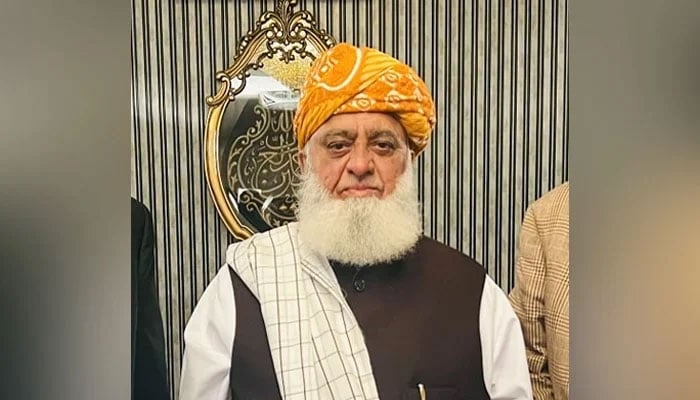
KARACHI: Jamiat Ulema-e-Islam Fazl (JUIF) chief Maulana Fazlur Rehman on Sunday strongly rejected what he described as a sustained campaign to malign religious seminaries, saying a false impression was being deliberately spread that madrasas limit the potential of young people and render them incapable of contributing to society.
Addressing the Tahaffuz-e-Madaris-e-Deeniya Conference at Maulvi Usman Park in Lyari, the Maulana said doubts were being systematically planted in the minds of people from various walks of life about the role and relevance of religious seminaries, without ever explaining why these institutions were established in the first place. He noted that before 1857, no such madrasa system existed in the Indian Subcontinent. “Even today, you will not find institutions of this nature elsewhere in the world. The question must be asked: why did these seminaries emerge specifically in the Subcontinent — in Pakistan, India, Bangladesh and Kashmir?” he said.
Tracing the historical background, the JUIF leader recalled that when the British established an educational institution in Aligarh under their supervision, they altered its curriculum by removing Quranic references, Hadith, jurisprudence (Fiqh) and even Persian, which was the official language of the Subcontinent at the time. “The objective was to detach Muslims from their religion,” he asserted.
Fazl said that in response, scholars of the Subcontinent took upon themselves the responsibility of safeguarding Islam and established Darul Uloom Deoband. “We became a reaction born out of the need to protect the Quran and Hadith,” he remarked, adding that the same colonial mindset persists today through bureaucratic and global establishments.
He lamented that after the creation of Pakistan, the bureaucracy refused to develop a unified national curriculum, repeatedly advocating “one education system” while compelling religious scholars to focus solely on the preservation of Islamic sciences. “The real threat to religious education today is not from the British or Hindus, but from within—from our own bureaucracy and establishment,” he said, expressing a sense of betrayal.
Criticising the country’s governance, Maulana Fazlur Rehman questioned the performance of state institutions over the past 78 years. “Which sector can you point to as a success story? Justice, economy, engineering, medical education — all have declined. The only sector that continues to stand tall at the global level is that of religious seminaries,” he claimed.
He argued that if the ideology of Pakistan is a living reality, its true interpretation and representation before the world is being carried out by religious seminaries and scholars. “If you wish to see Pakistan strong militarily and defensively, then why weaken its ideological strength?” he asked.
Calling for mutual respect, he said cooperation could not be one-sided and warned against being misled by “sweet words” used to justify harmful agendas. He pointed out that despite repeated negotiations and agreements with the authorities—and despite madrasas accepting conditions—conspiracies against them continued.
“We have no objection to the National Defence University, but we cannot accept turning madrasas into replicas of it,” he said. Referring to historical institutions such as Islamia College Peshawar and Jamia Abbasiya Bahawalpur, he lamented that wherever the state gained control, the religious identity of institutions was gradually erased.
Maulana Fazl stressed that millions of students were currently enrolled under various madrasa boards and vowed that no conspiracy against religious seminaries would be allowed to succeed. He rejected the notion of dividing knowledge into religious and secular streams, stating that the Quran encompasses governance, politics, law, and all branches of knowledge.
He also criticised what he described as state-backed promotion of “acceptable” interpretations of Shariah designed to please the West, questioning whether earlier generations were ignorant and only modern scholars had suddenly discovered the truth.
Referring to recent legislation, he said the madrasa law had been drafted by the government itself, accepted after consultation, and passed by parliament with their support. He rejected demands for madrasa registration under the Ministry of Education, terming them reflective of ill intent and hostility towards religious learning.
Concluding his address, Maulana Fazlur Rehman said that Pakistan’s army, bureaucracy and institutions were indispensable, but their purpose was to deliver justice and uphold rights, not to snatch them away. “Impressions are not formed by words but by conduct and character,” he said, urging a peaceful political system rooted in the traditions of elders. He also advised graduates of religious seminaries to follow in the footsteps of senior scholars in both religious and political engagement.