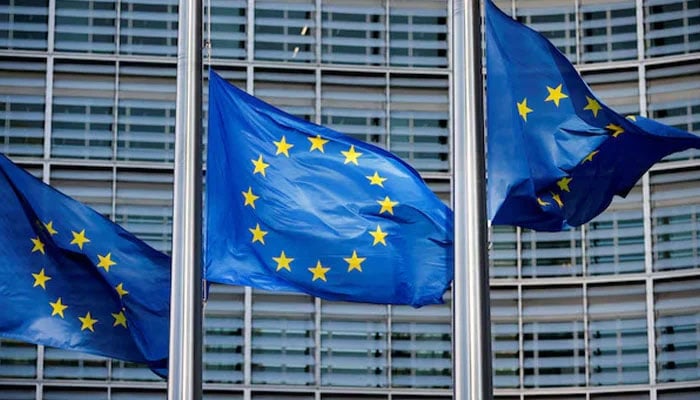
ISLAMABAD: Pakistan and the European Union reviewed this week in Brussels, Pakistan’s progress on the implementation of 27 international conventions as required under the GSP+ framework.
The EU is Pakistan’s second-largest trading partner, with Pakistan being the main beneficiary of the Generalised Scheme of Preferences Plus (GSP+) arrangement, contributing significantly to the growth of bilateral trade. The GSP+ monitoring report is now awaited.
Giving details of this crucial meeting as Pakistan continues to work on the 27 international conventions crucial to keep being the beneficiary of GSP+, the Foreign Office in a detailed statement pointed out that the EU welcomed progress made in bringing Pakistan’s application of the death penalty in line with international standards and encouraged further steps in this regard.
It also recognised important first steps against torture, as well as the creation of a Commission on Minorities. These discussions took place during the 15th European Union (EU)-Pakistan Joint Commission on Wednesday in Brussels. The Joint Commission was co-chaired by Muhammad Humair Karim, Secretary, Ministry of Economic Affairs of Pakistan, and Ms Paola Pampaloni, Acting Managing Director for Asia and the Pacific in the European External Action Service.
It was agreed to hold the next session of the EU-Pakistan Joint Commission in Islamabad in 2026.
“The meeting reviewed political and economic developments in the EU and Pakistan and discussed in depth EU-Pakistan cooperation in the fields of democracy, governance, human rights, trade and investment, development, migration, climate and energy, science and technology, as well as the implementation of the EU-Pakistan Strategic Engagement Plan (SEP),” noted the Foreign Office.
Both sides exchanged views on the regional situation and reaffirmed the importance of their longstanding partnership, underpinned by shared interest in promoting regional stability.
Reaffirming their commitment to the EU-Pakistan Strategic Engagement Plan (SEP) of 2019, the EU and Pakistan assessed progress achieved over the past six years.
“The EU encouraged further steps to be taken in the short term in view of the upcoming GSP+ Monitoring Report and reiterated the need for further reforms in the medium and long term”, admitted the FO.
Of importance were topics that the EU has pointed out several times and these saw views exchanged on these issues.
“Foremost was freedom of expression and media, enforced disappearances, the independence of the judiciary, freedom of religion or belief, anti-Muslim hatred, rights of persons belonging to minorities and vulnerable groups. Both sides underlined the importance of proportionality and appropriate safeguards and the need to continue dialogue on these concerns,” said the FO. Regarding labour rights, the EU and Pakistan discussed efforts to scale up and strengthen labour inspections, ensure respect of the minimum wage and enhance women’s opportunities in the labour market.
“The need for more systemic efforts were discussed in response to EU side’s concerns on low number of workers in trade unions in Pakistan,” said the statement.
The meeting of the Sub-Group on Trade saw the Pakistan side represented by the Ministry of Commerce and the EU side by the European Commission’s Directorate-General of Trade.
“During discussions in the EU-Pakistan Sub-Group on Trade, both sides acknowledged the importance of a robust multilateral trading system. EU-Pakistan bilateral trade relations were discussed at length, covering a wide range of topics including market access challenges for both sides,” added the FO.
Among other areas of specific interest, cooperation on the implementation of GSP+ was prominent. Both sides discussed follow-up of the GSP+ Monitoring Mission that took place from Nov 24 to Dec 3, 2025, including the upcoming GSP report and re-application to the GSP+ scheme under the new GSP Regulation.
Pakistan updated on progress under the National Action Plan on Human Rights and the National Action Plan on Business and Human Rights and on the work of various national institutions in charge of promoting and protecting human rights across the country.
“The EU reiterated its commitment to supporting Pakistan’s efforts to guarantee the protection of all human rights, including women and children’s rights, minorities’ rights, labour and migrant rights, as well as fundamental freedoms, such as freedom of expression and opinion including growing problem of disinformation,” said the FO.
At a time when Pakistan has all along taken a balanced position, avoiding taking sides in the Ukraine war, earning praise from Russian and Ukraine ambassadors recently, the EU in Brussels restated its position on Russia’s ongoing war of aggression against Ukraine.
The Pakistan side briefed on the issue of Jammu and Kashmir, as well as on the Indus Waters Treaty.
“Both sides stressed the importance of resolving conflicts peacefully and in full conformity with international law and the principles of the UN Charter. The two sides also discussed the situation in Afghanistan, security threats emanating from Afghan soil and the need for humanitarian assistance,” said the FO.
The EU welcomed the ongoing discussions between Pakistan and UNHCR to seek to identify and compile a list of vulnerable cases, to ensure their adequate protection. The EU appreciated that Pakistan is hosting millions of Afghan nationals for over four decades. They emphasized that any return must be safe, dignified and in line with international standards.
However, except for Germany, many EU capitals and the US have stranded Afghan citizens in Pakistan after promising to re-locate them.
Both sides affirmed their support to the implementation of Comprehensive Plan to end the Gaza Conflict, which allowed for a ceasefire, the release of hostages and better humanitarian access to Gaza.
Without naming Israel, both reiterated the importance of ensuring that all parties adhere to the ceasefire, implement all phases and refrain from any actions that jeopardise the agreement. The EU stressed its determination to contribute to the implementation of the plan by contributing to security, governance, recovery and reconstruction aspects. They underscored their support for concrete steps towards the two-state solution in accordance with the relevant UN resolutions.
The two sides also discussed issues of common interest and examined the potential for expanding co-operation in the area of climate change and environment, as well as in the fields of education, culture, science and technology, connectivity and digitalisation.
They appreciated the significance of EU-Pakistan knowledge partnership, in particular the growing participation of Pakistani students under the Erasmus Mundus scholarship programme.
Both sides also agreed to explore research collaborations under the Horizon Europe Programme. The Joint Commission took stock of progress under the EU-Pakistan Comprehensive Dialogue on Migration and Mobility, including co-operation on return and readmission within the framework of the EU-Pakistan Joint Readmission Agreement, as well as developments on legal migration under the EU-Pakistan Talent Partnership.
“The EU welcomed Pakistan’s concrete steps to improve cooperation on migration-related issues and its readiness to deepen the engagement, in particular on countering irregular migration and migrant smuggling. In this regard, the two sides noted with appreciation Pakistan’s support for the Global Alliance to Counter Migrant Smuggling and the participation of its Interior Minister, Syed Mohsin Naqvi, in the 2nd International Conference of the Alliance held in Brussels on 10 December 2025,” said the FO.
They also expressed satisfaction on the recent endorsement of the Talent Partnership Roadmap during the 3rd Migration and Mobility Dialogue.
On returns and readmission, both sides agreed on the importance of the full and effective implementation of the EU-Pakistan readmission agreement, also with a view to the implementation of upcoming Return border procedure as part of the Pact on Migration and asylum, and that the sharp decrease of irregular arrivals to EU Member States and increase in returns must continue.