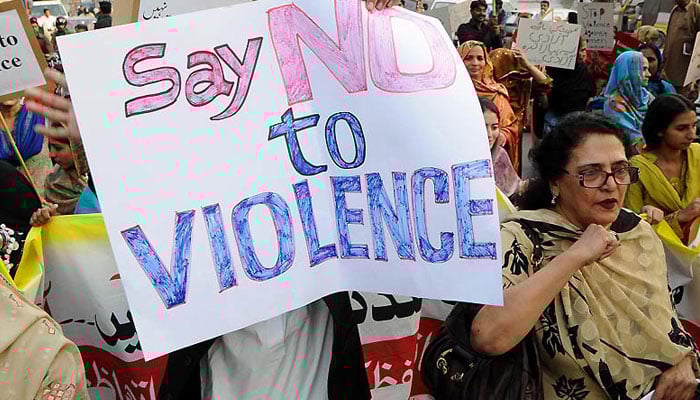
The 16 Days of Activism to End Gender-based Violence (November 25 to December 10, 2025) arrive each year with the same plea: listen to survivors, strengthen systems and confront the violence that shapes the lives of women and girls.
Yet, year after year, stories from Pakistan show how distant this aspiration remains from lived reality. Few cases capture this gap more painfully than the recent tragedy: In Kasur, a 13-year-old rape survivor set herself on fire after a court acquitted the accused policeman and his relatives, citing DNA-based doubt. She sustained critical burns and is now fighting for her life.
Her despair did not emerge in a vacuum. The accused policeman had already been dismissed after a departmental inquiry found him guilty, yet the criminal justice system still failed her. Flawed investigations have prompted the district police officer to order a fresh probe. This contradiction between administrative findings and judicial outcomes exposes a justice system unable to hold perpetrators accountable, especially when they come from within its own ranks.
Unfortunately, this echoes a nationwide pattern and may well be just the tip of the iceberg. Pakistan’s conviction rates for gender-based crimes are abysmally low: 0.5 per cent for rape and honour killings, 0.1 per cent for abduction and just 1.3 per cent for domestic violence. The Sustainable Social Development Organisation recorded more than 32,000 GBV cases in 2024 alone – including over 5,300 rapes and 547 honour killings – yet accountability remains elusive. Between 2021 and 2024, more than 7,500 women were killed in Pakistan, including 1,553 in the name of honour.
Despite 20 years of GBV laws, 70 per cent of cases never even make it into the state’s database – a consequence of the overwhelming justice barriers ordinary people face, compounded by other gender-marginalising structural blips. Physical distance, high financial costs, slow procedures and pervasive mistrust of legal institutions push many, especially rural and low-income communities, toward informal systems; unsurprisingly, Pakistan ranks 130th on the WJP Rule of Law Index 2025. When cases do surface, they collapse under weak investigations, mishandled forensic evidence, flawed medico-legal processes and months-long delays in challans and prosecutions. And with women constituting only 1-1.5 per cent of the police force, institutional imbalance shapes every stage of reporting and investigation.
This year’s global theme – ‘UNiTE to End Digital Violence against Women and Girls’ – highlights a rapidly expanding frontier of abuse. Digital violence is now one of the fastest-growing forms of gender-based harm. In Pakistan, the numbers reveal a crisis unfolding behind screens. The Digital Rights Foundation documented 3,171 cases of tech-facilitated GBV last year, most of which involved cyber harassment. Women filed 1,772 complaints, though 65 per cent of those who experience online harassment never report it, fearing stigma or expecting institutional apathy. And further, with the rise of AI, deepfake abuses disproportionately target women, globally, 90-95 per cent of deepfake content is sexual and features female victims. For many women, visibility online has become a risk rather than a right.
Pakistan’s existing protections have not kept pace with the speed and permanence of digital harm. Peca 2016 criminalises online harassment, sexual threats, and non-consensual image sharing, but concerns remain about loopholes and misuse, as well as the need for officer sensitisation and victim-friendly reporting mechanisms. Survivors often travel long distances to one of only 15 cybercrime police stations, sometimes borrowing devices from male relatives just to file a complaint, yet the prosecution rate remains just 0.6 per cent. The gap between the scale of harm, which is evolving far faster than oversight and regulation, and the state’s capacity to respond is staggering.
But digital violence, or GBV in general, is inseparable from the broader social, cultural, and educational context that leaves women vulnerable to harm both offline and online. Literacy data, for instance, reveals a foundation of inequality. Pakistan’s adult female literacy rate stands at 49 per cent – lower than the global average in 1976 – and even official estimates that place it at 53 per cent still mean half of adult women cannot read or write a simple sentence. Without education, women have reduced access to employment, reduced digital literacy and reduced pathways to autonomy. Educating a girl has multi-generational effects, yet financial constraints and cultural expectations often push families to withdraw girls from school first.
In the societal realm, Pakistan’s cities, markets and social systems remain shaped by patriarchal norms that marginalise women at every turn. Urban spaces – from dimly lit streets and unsafe sidewalks to male-dominated public transport and unwelcoming parks – effectively exclude women from public life. Economic structures add invisible burdens, with the ‘pink tax’ inflating costs of everyday products up to 30 per cent, while financial exclusion limits women’s autonomy and access to opportunities.
Health inequities worsen these disadvantages: 29 per cent of Pakistani women report chronic headaches, back, joint or muscle pain – a burden further intensified by mental and emotional stress. Panic disorder can trigger asthma; chronic anxiety raises the risk of heart disease, abdominal pain and weakened immunity; repressed anger can lead to hypertension and migraines; and unresolved grief often manifests as fatigue, insomnia and persistent pain. These educational, social, economic and health inequities create conditions that increase women’s vulnerability, making gender-based violence more likely and harder to escape, eroding rights, limiting agency and entrenching inequality.
Ending gender-based violence – digital or otherwise – cannot be achieved through legislation alone. Pakistan has laws, of course, and while there is always room for improvement, the real gaps lie in implementation, institutional capacity and societal will. Communities must challenge harmful norms, support survivors with empathy rather than suspicion and actively engage with organisations working for women’s rights.
One example of such an approach in action is the Jugnu Project, led by Zohra Ahmed. The project partners with government, NGOs and corporates to develop socio-legal frameworks addressing domestic violence, gender-based violence, child marriage and femicide. It connects survivors to services like legal aid, trauma therapy and transitional housing, provides capacity-building for field workers, and works toward a gender-just society, especially for the girl child. Notably, it maintains an online repository of GBV cases from across Pakistan, including cities and regions often ignored by mainstream media.
Given all this, the sixteen days of activism are insufficient; we need year-round efforts to undo inequality that extends back to antiquity. The state must ensure truthful, inclusive, participatory and credible reporting on CEDAW, CRC, UPR, the ICCPR, the ICESCR, CERD, the SDGs, Beijing+30, WSSD+30, and related commitments.
Most importantly, gender-based violence – whether physical or online – must be treated as the national emergency it truly is. This must be done not through reactive inquiries after tragedies, but through proactive enforcement, survivor-centred services and gender-sensitised systems, alongside a robust overhaul of the archaic patriarchal power structure, affecting, inter alia, the social, political and economic well-being of all genders.
The writer is a Peshawar-based researcher who works in the financial sector. He can be reached at: [email protected]