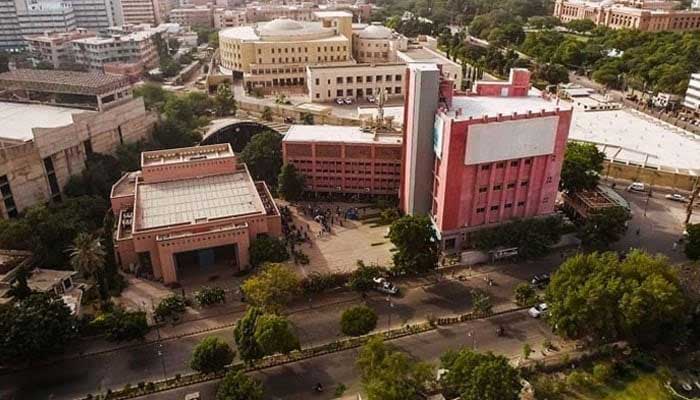
The Arts Council of Pakistan Karachi announced at a press conference on Tuesday that the four-day 18th Aalmi Urdu Conference 2025 – Jashan-e-Pakistan – would commence on December 25.
The press conference was attended by President Arts Council Muhammad Ahmed Shah, renowned poetess Zehra Nigah, eminent educationist and intellectual Prof Pirzada Qasim Raza Siddiqui, Vice President Munawar Saeed, Joint Secretary Noor-ul-Huda Shah, and Secretary Arts Council Ejaz Farooqi.
Ahmed Shah said the Aalmi Urdu Conference 2025 will continue until December 28 at the Arts Council of Pakistan. He said literary legends such as Fatima Surayya Bajia, Mushtaq Ahmed Yousufi, and Intizar Hussain always extended their guidance and support. He expressed gratitude to the media for providing continuous coverage of the World Culture Festival for 40 days and taking it to audiences across the globe.
He said the media plays a vital role throughout the year in covering cultural activities across Pakistan, whether in Sukkur, Hyderabad, Quetta, Lahore, or Kashmir. “Even if we organize ten thousand festivals, they will still not be enough,” he remarked, adding that the Pakistan Literature Festival is being taken across the country.
Shah said the World Culture Festival turned Karachi into a global cultural hub, and quoted the chief minister of Sindh as saying that while Karachi was once the capital of Pakistan, it is now the cultural capital. He recalled that the International Urdu Conference was launched 18 years ago during a period of severe ethnic violence, and that dialogue through literature helped carry the message of peace forward.
He further stated that alongside Urdu, Pakistan’s regional languages are also included in the conference. Writers and poets from Pakistan and around the world will participate. This year, the conference will celebrate Pakistani literature from 1947 to the present, with sessions on major poets, novelists, and short story writers, including special sessions in remembrance of departed literary figures, with the participation of women writers as well. Two international mushairas will be held, while Ayaz Fareed and Abu Muhammad Qawwal will also perform.
The ACP president said more than a hundred writers and poets from India had expressed their desire to attend, but due to suspended diplomatic relations, no invitations were sent. He emphasized that writers on both sides oppose war, stating that wars are not fought with weapons. He recalled that Pakistani and Indian writers had previously passed resolutions against war. He also remarked that film has become a major tool of propaganda, adding that responses to hostile narratives have been effectively given through cultural means.
Zehra Nigah said literature and language are the strongest pillars for elevating ethics in society. She stated that all languages spoken in Pakistan are national assets, and Urdu serves as a link language. She said that although she has received many awards, the trophy named after Sindhi poet Sheikh Ayaz remains the most cherished for her.
She emphasized that every form of literature in Pakistan -- Sindhi, Punjabi, Siraiki, Balochi, or Pashto -- deserves equal respect. She added that the Urdu Conference serves as a bridge between languages and will continue to keep Karachi’s name shining in the promotion of knowledge and literature.
Prof Pirzada Qasim Raza Siddiqui described the conference as a memorable and historic initiative, stating that it has gained global recognition in countries such as the United States of America, the United Kingdom, and Australia. He appreciated the Arts Council’s focus on engaging youth, noting that such literary activities play a crucial role in their intellectual and moral development.
Joint Secretary Noor-ul-Huda Shah said the Arts Council has proven that Karachi is a centre of culture and literature. She recalled that the International Urdu Conference began at a time when the city was engulfed in violence, and sustaining such a conference for years is a remarkable achievement. She said that despite threats, the Arts Council has continued to promote peace, culture, and continuity.