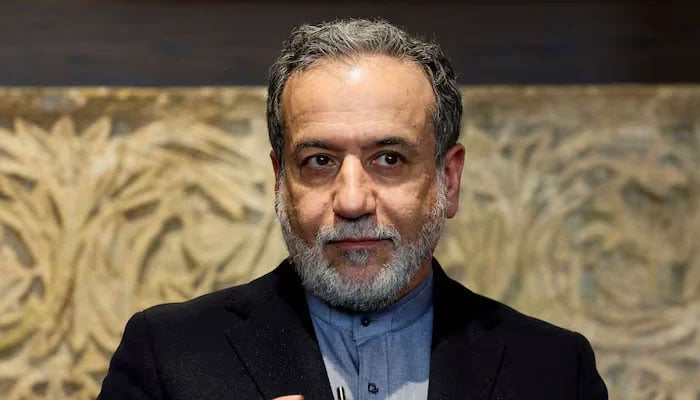
TEHRAN: Iran’s Foreign Minister Abbas Araghchi emphasised on Sunday that Afghanistan’s stability and development are essential not only for the country itself but for the entire region, as he highlighted the pivotal role of neighbouring countries in achieving sustainable security, development, and regional integration.
Speaking at the ‘Meeting of the Special Representatives of Afghanistan’s Neighbouring Countries Plus Russia’ on Sunday, he stressed that imported solutions and external decision-making cannot ensure stability in Afghanistan, IRNA reported.
Tehran hosted the meeting with the aim of discussing the latest developments in Afghanistan and South Asia. Attendees included representatives from Pakistan, Russia, Uzbekistan, China, Tajikistan, and Turkmenistan.
Afghanistan possesses unique human, economic, and natural capacities and has historically served as a bridge across neighbouring regions, Araghchi stated, adding that its geoeconomic position connects Central, West, and South Asia, making its stability a strategic necessity.
Highlighting lessons from past foreign interventions, the minister said that external decisions, including military interventions and two decades of Nato presence, failed to bring lasting peace or sustainable development.
He argued that overly security-focused approaches, disregard for Afghanistan’s social and cultural fabric, and neglect of regional actors contributed to these failures.
The lesson is clear that no external solution can resolve regional crises. Imported decisions do not guarantee stability, but regional, neighbour-driven solutions hold far greater potential, he emphasised.
The minister said that Iran has consistently advocated for Afghanistan’s full regional integration and stressed that neighbouring countries, with their historical, cultural, and economic ties, are best placed to facilitate cooperation.
Araghchi called for a coordinated regional framework that moves beyond short-term rivalries and prioritises collective security, shared interests, and sustainable development.
He underscored the importance of practical cooperation in trade, transport, energy, and cross-border relations to enhance Afghanistan’s role as a key transit hub linking Central, South, and West Asia.
A stable and connected Afghanistan benefits the entire region; therefore, the Afghan people should be at the centre of all efforts, he said.
Esmaeil Baqaei, spokesperson for Iran’s Foreign Ministry, said that the meeting reflects ongoing consultations with neighbours, including Pakistan and Afghanistan, aimed at promoting peace, reducing tensions, and fostering regional cohesion.
According to Baqaei, Iran places great importance on the security and stability of its neighbourhood and spares no effort to reduce tensions between regional countries and to promote mutual understanding among them.
Meanwhile, Iran’s Foreign Ministry spokesperson Esmaeil Baqaei said Iran attaches paramount importance to its neighborhood and border security, including along its eastern borders with Afghanistan and Pakistan, emphasising that any tension between the two countries would inevitably affect Iran as well. Baqaei made the remarks on Sunday during his weekly press briefing while commenting on the meeting hosted by Iran the same day on the situation in Afghanistan.
“Iran shares a total border of nearly 2,000 kilometres with Afghanistan and Pakistan. Any tension that arises between the two countries will inevitably affect us as well. Other countries have similar concerns, which is why we have invited them to participate,” the spokesperson said.
He added that Afghanistan had been invited to the meeting, as Iran believes Afghan participation in such processes could enhance mutual understanding and help resolve issues between Afghanistan and its neighbouring countries. Afghanistan, however, chose not to attend the meeting, a decision that Iran “respects,” he said.
According to the spokesperson, the participating countries exchanged views on regional developments, including the recent border tensions between Pakistan and Afghanistan. “Through this meeting, the Islamic Republic of Iran seeks to help build regional consensus and identify solutions that will strengthen security and stability in the surrounding environment and among regional countries,” he said.
In a post on his X account on Sunday, Pakistan’s Ambassador to Iran Muhammad Mudassir Tipu said that Pakistan Prime Minister’s Special Representative for Afghanistan Affairs Mohammad Sadiq met and held talks with Iranian Foreign Minister Abbas Araghchi in Tehran.
“Recalling closer interactions taking place between leaderships of both countries at the highest levels in the past two years, Mr. Araghchi reaffirmed Iran’s commitment to further deepen and widen its ties with Pakistan,” he added.
He further noted, “The Special Representative thanked Iran for hosting a meeting of neighboring countries of Afghanistan and Russia and hoped that the meeting will play a useful role in promoting peace and development in the region.”
The Special Representative of Pakistan, Mohammad Sadiq Khan, also addressed the meeting, emphasising that Islamabad’s concerns about terrorism must be addressed, Tolo News reported. He reiterated that Pakistan seeks to promote peace, development, and security in the region.