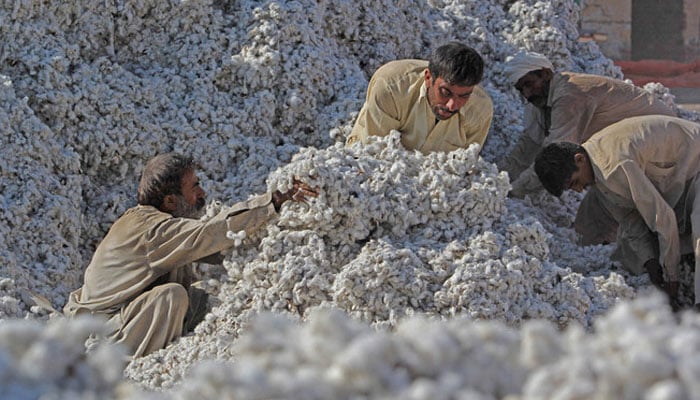
LAHORE: Pakistan’s cotton landscape has been quietly reshaped over the last five years. Once overwhelmingly dominated by Punjab, cotton production is now split evenly between the provinces, with Sindh emerging as the new powerhouse.
Cotton is the raw material backbone of Pakistan’s textile industry; the sector that exports yarn, cloth and garments, and employs millions. A shrinking and unstable cotton harvest in Punjab disrupts supply to ginners and spinning mills, while rising dependence on Sindh concentrates risk in a smaller geographic area. For textile manufacturers and exporters, supply-chain resilience becomes more fragile. For farmers, the shift may deepen inequality: cotton-growing districts in Punjab risk losing out, while Sindh districts may attract more investment; but also bear more environmental and market risks (monsoon rain variability, soil salinity, water stress).
This reversal is more than symbolic: it threatens to reshape textile supply chains, farmer livelihoods and regional agronomic patterns for years to come. At the start of the 2021-s22 crop season, Punjab was still firmly in command, producing roughly 5.17 million bales of seed cotton against Sindh’s 3 million. That year the imbalance still reflected decades of Punjab-centric cotton cultivation -- more acreage, better irrigation systems and a legacy of agronomic practices tailored to cotton.
But cracks had begun to show. In 2022–23, Punjab’s output plunged to just 3.21 million bales -- less than half of its earlier target -- as water stress, delayed sowing and pest pressure reportedly took a heavy toll. Sindh, too, under-produced, but the drop was less severe, and the gap between the provinces shrank.
The 2023-24 season brought hopes of a rebound. After a major flood-disrupted 2022, ginners’ intake recovered significantly, and public estimates indicated a jump in national arrivals. Still, the gain was not equally shared.
By 2024-25 the shift became unmistakable. PCGA data for that season shows total seed cotton arrivals at about 5.51 million bales, with Sindh contributing slightly more than Punjab -- around 2.806 million bales vs 2.704 million bales. Considering Sindh cultivates considerably less cotton acreage than Punjab, the near-parity in output underscores a serious blow to Punjab’s per-hectare productivity or area under cotton.
And by late 2025, the trend had become a structural realignment. The national tally of 5.133 million bales was split roughly 51:46 in Sindh’s favour, marking the first time in living memory that Sindh overtook Punjab in cotton arrivals.
Experts and industry insiders point to a cluster of overlapping factors. For Punjab: repeated heatwaves, erratic irrigation, waterlogging in some districts and rising prevalence of pests such as whitefly and pink bollworm degraded yields. Concurrently, many farmers switched to alternative crops -- maize, rice, sugarcane -- in search of better or more stable returns. Reports suggest that seed quality, weak extension services, and unreliable market signals (low cotton prices) further dampened cotton’s appeal in Punjab.
Sindh, by contrast, seems to have avoided some of these issues. Earlier sowing windows in many districts allowed cotton to mature before the harshest heat; irrigation systems in key cotton-growing districts remained functional; and yield management (pest control, timely harvesting) appears to have been comparatively better. The result: Sindh’s yield per acre outpaced Punjab’s, and while its acreage is lower, output held up better.
Many analysts argue that with timely interventions -- provision of high-quality, pest-resistant seed; early sowing support; improved water management; and stable cotton-support price or MSP -- Punjab could regain part of its lost ground. On the Sindh side, diversification of production zones (spreading cotton acreage across more districts) could reduce concentration risks. But success depends on treating cotton not just as an annual cash crop, but as a strategic agricultural sector -- one that needs stable policy, investment in agronomy, and risk mitigation.
It is however clear cotton is no longer a ‘Punjab affair’. It has become a Sindh-anchored enterprise -- with big implications for textile mills, rural livelihoods and national agricultural strategy.