


Print Story
X


Yaseen Khan turns Chamak Patti, the reflective tape used to decorate Pakistani transport, into art
| I |
n most art schools, the first exercise is usually about the line: teaching students to understand the nuances of this basic visual element, its width, length, direction, angle, movement, shade, colour and texture. One aspect, however, is often missing: its reflective quality.
A person with no formal art education may develop a very different visual preference. It appears in the patterns on public transport, decorative plastic pieces, glittering garments and garish decorations at weddings, family functions and religious celebrations. Think, for instance, of the small, seemingly innocent settings put up in open spaces to commemorate the birth of the Holy Prophet (peace be upon him).

We come across these visuals on transport and artefacts and ignore, enjoy or dismiss them, but are hardly interested in knowing their makers. The people who create them, like the vehicles decorated with intertwined motifs, are taken for granted. Their work, their aesthetic choices and the human hand behind them go largely unacknowledged.
Not surprisingly, these unknown fabricators of an art form remain less visible than the parts of a machine, which are labelled and catalogued.
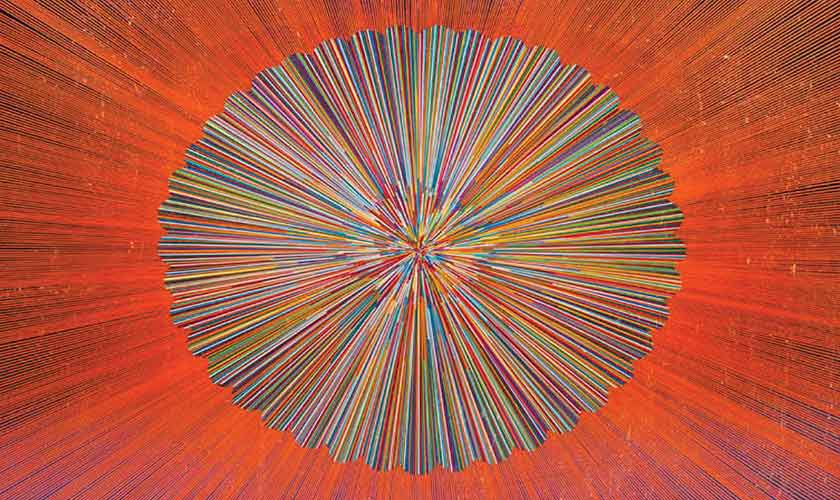
Yaseen Khan, whose solo exhibition Line After Line (September 8-17) is currently on display at Canvas Gallery, is familiar with the makers, methods and imagery of local buses and trucks, distinctive visual forms marked by layers of reflective tape, Chamak Patti.

Khan grew up in Hyderabad and, from an early age, worked as a mechanic next to a truck-decoration shop. He became fascinated by colour and pattern, but above all by the way a metallic body could be transformed into a medley of elaborate designs.
This early exposure began to fade when Khan enrolled at an art institute. Already an accomplished draftsman before beginning his formal studies, he explored various genres at the National College of Arts. By his graduating year, however, his encounters with reflective material had begun to re-emerge, gradually and naturally, in his large canvases.
What was an exotic material to others was familiar to Khan. It subsequently became part of his artistic identity and a permanent feature of his work.
A stage that brings comfort, can cause confusion too. It is easy to produce work after work with minor shifts in size, composition and chromatic variety; the difficulty is finding a way out. How to evolve, move in other directions, discover a new strategy. These are questions that haunt creative individuals, each seeking a separate solution.
In Yaseen Khan’s case, his home-grown Chamak Patti becomes a dormant segment, unlike the odd, low-taste glossy sheets picked up and used by a few Karachi artists in the 1990s. Rather than elevating this mundane material into ‘high art,’s Khan treats it as a substitute for paint, applying it to the canvas much as painters work with conventional materials in art schools and studios.
Handling the material, particularly when covering large surfaces, requires patience, precision and physical endurance. It is a process suited to someone who, in his own words, has had “an experience of labour.”
The journey of reflective tape is significant to Yaseen Khan’s practice. While still working as a mechanic, he had “gradually learnt the craft and began working with Chamak Patti out of curiosity and personal interest.” He later recognised its potential to produce abstract compositions that could appear radically different from conventional transport art, while retaining, through their non-representation, a connection with the abstractness embedded in truck decoration.
The link is not merely in the material, but also in its essence and intention. Abstract art, which inspired generations of artists across continents, is evident to some extent in Pop Art as well. Both movements sought to remove the viewer from familiar reality and relocate them elsewhere into shapes and forms detached from recognisable objects.
In Pop Art, artists altered the viewer’s orientation towards the ordinary, readjusting it to create a new version of everyday life. Geometric spaces, solid hues and industrial materials were among the tools used to achieve this.
Abstraction in our culture emerged differently, through arrays of colourful forms covering the goods and transport vehicles on the roads. One may ask: if this is such a popular characteristic and sensibility of the society, why is it not visible on cars and motorbikes, particularly since buses, trucks and personal modes of transport are largely assembled or replicated here?
This distance in approach parallels the way several artists have treated ‘transport art.’ It enters their work but behaves like a domestic worker at an employer’s house: allowed a designated space, feeling privileged to be part of the setting, even temporarily, and content to work as directed; never to initiate a discussion or stay longer than required.
In contrast, many artists have included transport art by recognising its meaning and acknowledging its contribution to shaping the visual culture of a community. They respond to it not as an alien diction, but as another accent among several that together construct the language of a particular culture.
Yaseen Khan belongs to the latter league. He incorporates the material and pictorial sensibility of transport art into his imagery, like wearing an old pair of trousers that are still fashionable and in good condition. It is different from wearing something completely out of place in one’s surroundings, which can make even familiar gestures feel unnatural. Ease and confidence return when the body is back in familiar clothing, free to move without constraint and, at times, unexpectedly.
Khan’s comfort is reflected in his perception of Chamak Patti. He is not bound by the conventions of transport art, but uses the material as a means of creating a distinctive body of work. Recognising the materiality of reflective tape, he has transformed what he observed into what he imagined, perhaps the two are, for him, the same phenomenon.
Some of his paintings deal with formal concerns: webs of crossing and overlapping lines, circular and semi-circular forms, and expanses of tiny squares. These glowing configurations acquire an independence of their own because what they offer the viewer resists easy interpretation.
The interaction between the viewer’s eye and Yaseen Khan’s surfaces unfolds in much the same way in works that remain remotely connected to observable reality, the sun, moon, trees, flowers, landscapes and buildings. Tangibility is transformed through stylisation, simplification and reduction, heightened by the vividness of Chamak Patti.
Here, the material is no longer a casual choice for rendering a subject, but an existential matter: an ordinary material associated with uneducated artisans who make a living decorating trucks and buses becomes a crucial instrument in Khan’s visual world. Its engages the viewer’s gaze in a way not unlike what the Swedish Nobel laureate Tomas Tranströmer observes in his poem:
“I drive through a village at night, the houses rise up/ in the glare of my headlights—they’re awake, want to drink./ Houses, barns, signs, abandoned vehicles—now/ they clothe themselves in Life.”
The writer is a visual artist, an art critic, a curator and a professor at the School of Visual Arts and Design, Beaconhouse National University, Lahore. He can be contacted at [email protected].


