Print Story
X




While the spirit of sacrifice remains alive, economic conditions make it harder for people to translate it into practice
| A |
few days before Eid-ul Azha, twelve-year-old Iqra asked her mother a question that carried more weight than she knew.
“Ammi, why are there so few animals in our society this year?”
There was no easy answer.
The family lives in a mid-income neighbourhood in Karachi where, in previous years, the courtyards and car parks would fill up with goats and bulls in the week before the festival of sacrifice. This year, the lanes are quieter. Iqra is too young to connect the dots between the fuel price shock that followed the US-Israel war on Iran; the inflation that spread through Pakistan’s import-dependent economy in its wake; and the market price tags that have forced a growing number of families to simply walk away.
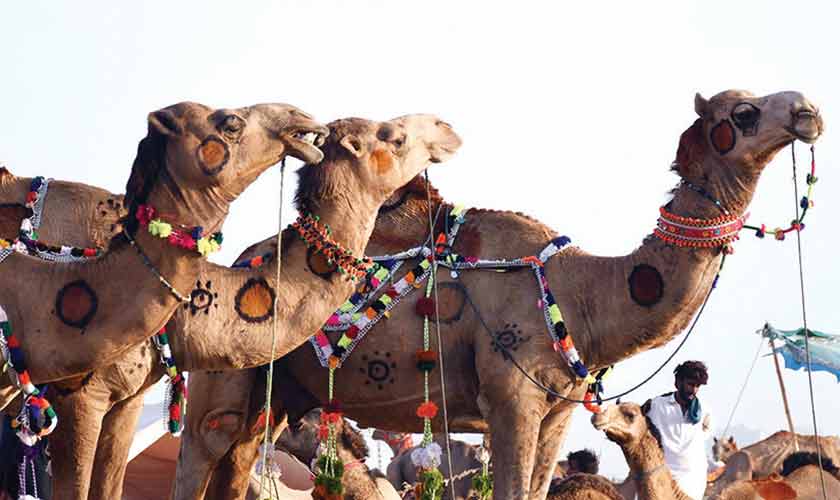
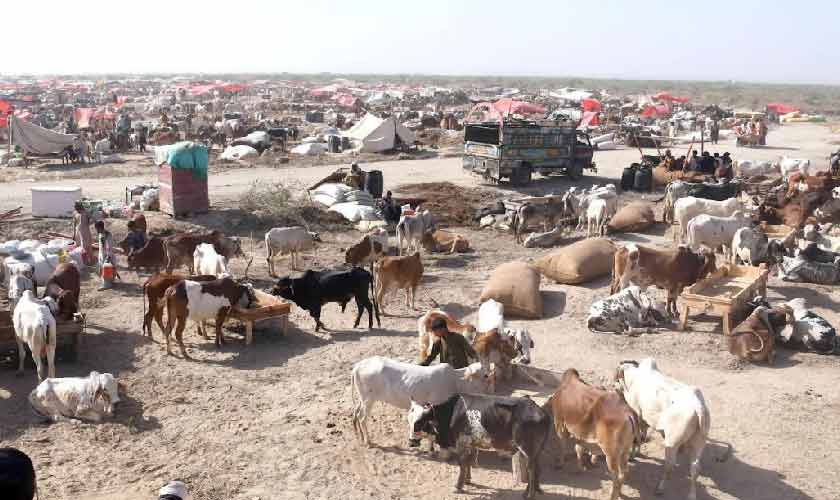
The air along Karachi’s Northern Bypass smells of hay, dung and commerce. Weeks before Eid-ul Azha, Pakistan’s largest sacrificial animal market is already in full, heaving swing. Truckloads of goats from Rajanpur; bulls from Muzaffargarh; and camels from Balochistan rumble through the gates at all hours.
Yet, for the thousands of families who make this annual pilgrimage in search of the perfect animal, the experience this year comes with a familiar but deepening sting: the price of piety has climbed sharply.
A city of 21 markets
Karachi’s administration has moved to expand access. The divisional commissioner has approved 21 cattle mandi locations across the city for Eid-ul Azha. District Malir will feature two traditional markets at Asoo Goth and Cattle Colony; District South will have two locations and District Keamari one approved cattle market. All organisers must strictly follow standard operating procedures, including ensuring that there is no traffic obstruction, maintaining hygienic conditions, implementing adequate security measures and preventing noise and odour nuisance.
The Karachi administration has also made it mandatory for the vendors to obtain official permits before establishing any cattle market. The permits are issued with the approval of the commissioner and after consultation with police and traffic authorities.
By early May, the Northern Bypass cattle market, widely known as Karachi Mandi, had completed a month of operations with the number of animals crossing 100,000. At the time of writing this report, the main Northern Bypass market was handling around 150,000 animals, with the remaining 20 official markets and several unofficial ones across the city accounting for a further 150,000, bringing the total estimated arrival of animals in Karachi to approximately 300,000 this season.
The range of livestock on offer remains impressive despite the economic headwinds. Daily truckloads of animals arrive from the Punjab, the Khyber Pakhtunkhwa, Balochistan and rural Sindh. The market spans over 1,000 acres and is divided into 20 organised blocks, with separate areas for VIP and VVIP buyers.
A steep climb
Some buyers report sharp increase in prices. Buyers say the cost of animals has increased significantly compared to previous years. Goats that were once available for around Rs 50,000 are now being sold for more than Rs 100,000. In several urban cattle markets, goats that previously sold between Rs 100,000 and Rs 125,000 are now priced as high as Rs 180,000 to Rs 220,000.
For cows, the picture is similarly unforgiving. Last year, a well bred cow weighing about three maunds was available for Rs 180,000 to Rs 200,000. This year, although supply is ample, partly due to the closure of cross-border trade routes, prices are expected to hover above Rs 200,000.
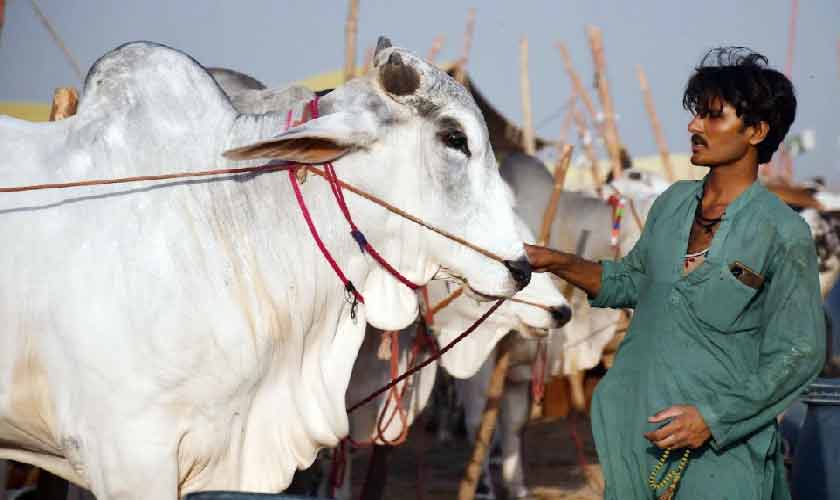
Collective sacrifice arrangements, in which seven individuals share the cost and meat of a single cow, remain a popular workaround. The price of a share in a bull has been fixed at Rs 28,000 to Rs 35,000 per share. Organised farm services offering home-delivery of meat are advertising comparable rates.
The buyer-seller gap
Wilayat Ali has spent years watching the rhythm of Karachi’s sacrificial animal trade. He knows the market moods, its pressure points and the invisible line where aspiration meets affordability. This year, he says, that line has been crossed by too many traders.
“A majority of people in Karachi can afford animals between Rs 180,000 and Rs 300,000,” he says. “But traders started their prices from Rs 400,000. So many people returned empty-handed.”
His observation captures the central tension this Eid.
The Northern Bypass market arrived well-stocked. But the prices are calibrated for a buyer class that stands on thinner ground than it used to be. Ali notes that some relief did materialise. After the start of Zil Haj, traders facing unsold inventory began lowering prices to a degree, allowing some buyers to complete purchases. It was cold comfort for families who had already given up.
Why prices rose
Traders are quick to point to pressures beyond their control. Feed and fodder costs have risen by 20 to 30 percent compared to last year due to general inflation. Transport charges for bringing cattle from the Punjab and Sindh farms to Karachi have also increased significantly. Inflation, increasing fuel prices, higher fodder costs and expensive transportation have collectively driven animal prices upward, making the overall cost of sacrifice significantly higher compared to previous years.
The fuel price shock, a downstream consequence of the military confrontation in the Middle East that roiled global energy markets earlier this year, hit Pakistan with force given the country’s heavy dependence on imported petroleum. Everything that moves in Pakistan moves on fuel and livestock trucks are no exception.
The cost of transporting a herd of bulls from southern Punjab to Karachi has risen in step with pump prices and traders have passed on that cost. Livestock traders argue that their own costs have surged due to increased transport expenses, fodder prices and logistical challenges in moving animals from rural areas to cities.
“Every category of animal has become significantly more expensive this year,” says Ali Hyder, a buyer, adding that many consumers are hoping for price adjustments closer to Eid.
Citizens have complained that traders are demanding excessive prices, making it difficult to purchase sacrificial animals and have urged the administration to ensure price monitoring in cattle markets to control artificial inflation.
Feeling the heat
The social mathematics of Eid-ul Azha in a city of 20 million people is not trivial. Karachi accounts for a substantial share of Pakistan’s national qurbani numbers. Historical data offers some perspective: in 2024, around 700,000 sacrificial animals were brought to the Karachi market, of which 600,000 were sold, a figure the administration describes as record-breaking, generating business activity worth Rs 8 billion during that season.
This year’s estimate of 300,000 animals across all Karachi markets, roughly half the 2024 intake, suggests that the price raise has had a measurable effect on participation, even if the most devoted buyers have found ways to make do.
Digital mandi
Some buyers prefer to wait until the final days before Eid in the hope of lower prices; others are increasingly turning to online qurbani services for convenience. Platforms offering farm-to-doorstep delivery of animals or fully managed sacrifice and meat distribution services have multiplied. Demand for organised collective qurbani services in Karachi is increasing each year, as more families move toward shared sacrifice arrangements.
The appeal is practical.
Urban families, particularly in Karachi’s apartment-heavy DHA and Clifton districts, face restrictions on where they can slaughter. The noise; the crowds; the heat of late-May; and the challenge of transporting an animal through gridlocked streets are all powerful incentives to outsource the process entirely.
Faith holds firm
For all the economic strain, mandis continue to draw thousands daily. From early morning until late at night, thousands of people arrive daily in search of suitable animals for sacrifice. Social media platforms are increasingly showcasing videos of healthy and attractive animals, further boosting public interest and market engagement.
Back in her neighbourhood, Iqra will almost certainly see at least a few animals arrive in the days before Eid. Pakistan’s relationship with qurbani runs too deep to be undone by one difficult year. But the quieter lanes; the buyers who came to the Northern Bypass and left without an animal; and the traders who only started negotiating after Zil Haj began all tell the same story. While the religious and social significance of Eid-ul Azha keeps the spirit of sacrifice alive, the gap between intention and affordability has rarely felt quite so wide.
The writer is a senior financial correspondent at The News. He holds Alfred Friendly, Daniel Pearl and Geo Journalism fellowships. He can be reached at [email protected].