Print Story
X




The broken promise of safe milk in the Punjab
| L |
oose milk sold in Pakistan poses a major health threat due to rampant contamination and adulteration in an unregulated supply chain.
The pasteurisation law in the Punjab has missed several enforcement deadlines.
Punjab Food Authority enacted a law in 2017 to ban unpasteurised loose milk sale in the Punjab under the Punjab Pure Food Regulation 2017. The PFA planned then to phase out the loose-milk supply across the Punjab in five years — by 2022.
The Punjab Pure Food Regulations, 2017, were repealed upon the enactment of the Punjab Pure Food Regulations, 2018.
In 2019, a report was submitted to then-prime minister Imran Khan by provincial authorities. It said that 70 percent of the loose milk sold in urban Punjab was contaminated and not suitable for consumption. Out of the 601 samples from Lahore, Faisalabad and Multan, 442 were found unfit for consumption.
The report accused a milk adulteration ‘mafia’ of using smuggled powdered milk from Iran and mixing it with ghee and water to produce fake milk sold at high profits. Khan directed Jahangir Tareen to work with the provincial authorities on a Turkey-style pasteurisation policy, based on the Punjab Pure Food Regulations 2018. The proposal included labelling standards and a five-year transition period.
In February 2022, the provincial government said it was all set to implement the Minimum Pasteurisation Law by July 2022, with a pilot programme scheduled to begin in Lahore from March 2022. The enforcement would start from Model Town. After assessing the feedback, the government would extend it to the rest of Lahore. In the third phase, the project would be replicated across the Punjab.
The Punjab Food Authority said, “sale of loose milk shall not be allowed; all milk offered for sale shall be pasteurised as a mandatory requirement.”
“Anyone or any cooperative engaged in producing, pooling and selling milk to intermediaries or companies for distribution to end consumers prior to pasteurisation must obtain registration with the Punjab Food Authority in the prescribed manner. Additionally, they must assist the processor in identifying the milk’s origin to ensure accurate record-keeping and traceability both before and after pasteurisation.”
In December, 2022, a survey was conducted across the country by the University of Veterinary and Animal Sciences on milk quality and safety. It concluded that 91 per cent of loose milk samples did not meet the required quality and safety standards. The survey was carried out in 11 cities of Pakistan in collaboration with Nielsen.
According to Food and Agriculture Organisation of the United Nations, Pakistan is the third largest milk producing country in the world, following India and the United States.
In January 2023, the PFA announced a ban on loose milk across the Punjab under the pasteurisation law. Then-DG of PFA, Mudassar Riaz Malik, said that enforcement would start soon. There has been no progress since then.
The loose milk trail
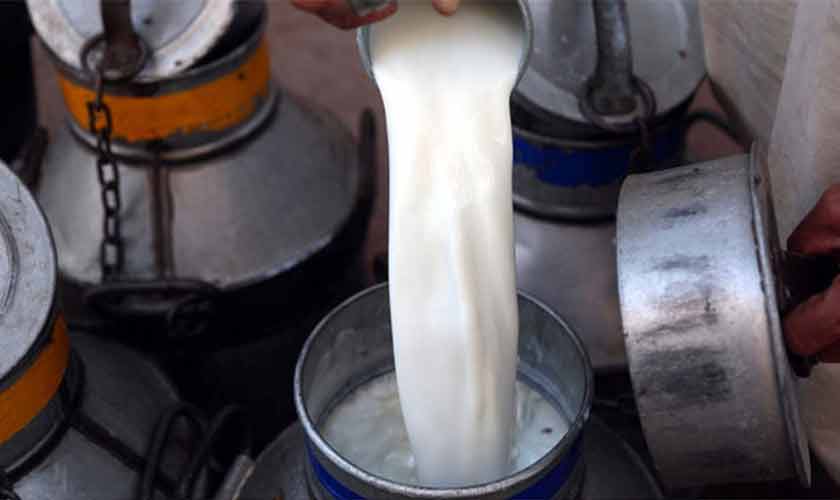
Milk is traditionally purchased from gawalas (milk sellers) and boiled before being consumed. Most Pakistanis are unaware of the numerous health risks associated with loose milk.
The process of collecting raw milk and delivering it to consumers begins at traditional dairy farms. At some of these cows are treated with hormones and other drugs to boost productivity. Sanitation standards are not consistently enforced at these livestock sheds. Unsanitary handling and poor milking practices can cause bacterial contamination of the milk.
The milk is often exposed to the open air, which increases the risk of contamination from airborne bacteria.
Dairy farms typically store milk in containers that are not sanitised. It is then transported either directly to consumers or to retail shops.
Careless handling at retail vendors can add to the contamination.
Some unscrupulous venders are also known use unsafe water and/ or harmful chemicals (starch, urea, preservatives) to maintain/ improve the milk’s appearance.
Pasteurised milk
Punjab Pure Food Regulations, 2018, defined pasteurised milk as follows:
“Pasteurised and their grammatical variations when used to describe a dairy product mean that every particle of such product shall have been heated in properly operated equipment to one of the temperature specified in the table of this paragraph and held continuously at or above that temperature for the specified time.”
If the fat content of the milk product is 10 per cent or greater; or total solids 18 percent or greater; or if it contains added sweeteners; the specified temperature shall be increased by 3ºC. Pasteurised milk should have a negative phosphatase test.
Pasteurised milk is a liquid product made of fresh raw milk sourced from halal milk animals, processed through pasteurisation, to completely destroy the vegetative bacterial pathogenic micro-organisms and cooled immediately to 6°C after processing.
Dairy and Cattle Farmers’ Association Pakistan president Shakir Umar says that when milk is bought from farmers or milk retailers, people do boil it at home. He argues that there is no need for the pasteurisation law.
Dr Sanaullah, chairman of the Food Science and Human Nutrition Department at the UVAS, says that “pasteurization doesn’t just mean heating the milk. The main issue is traceability. That was the main purpose behind the legislation.
“The director general of the Punjab Food Authority admitted that 80 percent of the milk sold in Lahore was untraceable. When milk is packaged, it becomes traceable. If there’s ever a quality issue, the source can be identified and held accountable.”
Muhammad Asim Javaid, the Punjab Food Authority director general, says that the law was made in a haste.
“If you don’t even have the infrastructure, requiring a process is an inappropriate approach… We want this to happen — but in the right way.
“First, all stakeholders must be taken into confidence. Second, the infrastructure required for complete pasteurisation should be in place. These are the two prerequisites. We said the same thing in the Special Investment Facilitation Council.”
“A small farmer or shopkeeper cannot afford to pasteurise milk before selling it. We believe that this will discourage small farmers. The pasteurisation law will benefit multinational companies.”
Dr Sanaullah argues that the public and private sectors can collaborate to set up processing plants. He says gawalas should be required to deposit milk at these facilities, where it can be pasteurised, packaged and handed back to them.
Javaid says “the 2017 decision was wrong. Now industry people bring it up every other day and demand that loose milk sales be banned. But if the customers are happy buying loose milk, how can we completely ban it? Last year, packaged milk had about 11-12 percent of the market. It has now dropped to around 8 percent. At the end of the day, the consumers prioritise their convenience.”
He suggests that if a ban is imposed on loose milk, the farmers may go on a strike and refuse to sell the milk.
Dr Sanaullah says the plan was to set up processing units at Lahore’s entrances. Milk would be collected, tested, pasteurised and packaged, chilled and handed back to the gawalas for distribution.
He said the key stakeholders were reluctant to make the change as they were making higher profits from selling adulterated milk.
“Perhaps the regulatory bodies are not strong enough to effectively implement the plan, either.”
Shakir says the RBST (recombinant bovine somatotropin) is being smuggled into the country and widely used. He says this injection requires a cold chain for transportation. Otherwise, it gets spoiled. He says oxytocin should also be banned. He says bacterial growth in milk begins right after milking. To prevent that, pastuerisation plants must be installed at the farm level. We also need to develop a cold supply chain. He says enforcement of the pasteurisation law will essentially hand over the market to big companies.
Dr. Sanaullah disagrees. He says, “changes can certainly be made in the implementation process, but implementing this law is absolutely essential. It was designed very carefully. If the Punjab Food Authority or any other regulatory body believes that some changes are needed, they can make those changes. But the implementation is critical. If we don’t introduce a minimum pasteurisation law, and if we don’t ensure the milk we consume is pure, then we’re compromising public health.”
Javaid says the PFA is “working on the milk regime. The Milk Sellers’ Associations, Pakistan Dairy Association, the Livestock Department and the Punjab Food Authority, are part of it. We have formed various committees. One of the committees is focusing on research — specifically on how farmers can be incentivised and how the industry can be localised to ensure pasteurisation.”
The writer is an associate producer at the Geo Election and Research Cell.