Print Story
X




Those who protect the forest through their daily restraint are the ones most harmed by its destruction
| S |
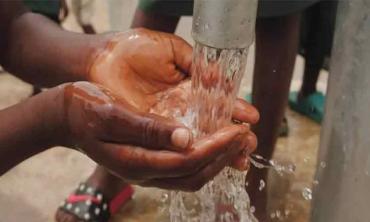
everal times a day, groups of women begin a silent procession through the steep hills and broken trails in Galliat. Carrying metal containers, they walk, sometimes barefoot, towards the last remaining natural springs. These springs, nestled deep within forested gullies, have become lifelines in villages where piped water never arrived.
Their journey is not a traditional trek; it is a necessity. The Galliat forests and rich understory filter water and feed the groundwater, but these ecosystems are being rapidly cleared. What remains is a trickle of clean water and so the women walk; every day, for hours, making many trips because they can carry only so much water.
Like many women in Galliat, this is the story of a bright young woman, Rubana, whom we met recently in Nagribala. Rubana lives in a community of 25 families. Her happiest days are when it rains as that is when she gets a holiday from her routine treks to the spring. Snowfall is even more joyous as snow and intermittent sunshine provide a regular water supply. But with climate change, snowfall patterns are changing. This year, communities in Galliat felt that there was little snowfall in Galliat and that too late in the season.
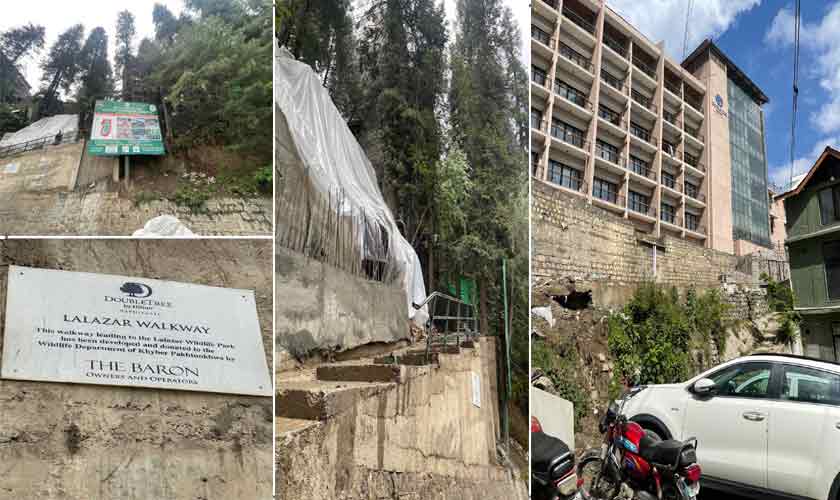
Ironically, just about eight kilometers away, concrete is rapidly unfolding across the landscape surrounding the Ayubia National Park, a UNESCO site and habitat of threatened species such as the common leopard. The high riser ‘Double tree by Hilton’ proudly presents a 100-room hotel and a helipad carved into mountainsides, bleeding silt into fragile watersheds. The building rises where the conifer forest once stood in front of the Lalazar track. Now the entrance to this track is from the road with a huge concrete staircase ‘donated’ by Hilton by Barron. This is not an isolated development. Construction for luxury hotels and tourist infrastructure under the guise of eco-tourism is steadily claiming what is sacred: forests that hold the water, shade the springs and anchor the slopes.
There is no way that the natural tree regrowth can keep pace with this rapid ecological degradation. Women’s footsteps are not just part of a pastoral image but part of an unpaid, unrecognised system that keeps communities alive.
These projects boast tourism - or better still, ecotourism, but that claim cannot be swallowed without a pinch of salt. According to The International Eco-tourism Society, eco-tourism is “responsible travel to natural areas that conserves the environment, sustains the well-being of local people and involves interpretation and education.” The International Union for Conservation of Nature defines eco-tourism similarly but emphasises that it must directly contribute to bio-diversity conservation and community development. Yet, these large scale projects often bypass environmental impact assessment requirements from the Galliat Development Authority and are epitome of short-term planning. Their water demand far exceeds what the land can offer. Tankers roar up half-paved roads to refill hotel tanks, drawing from streams and boreholes. While private taps gush into porcelain washbasins, women walk further with every passing year chasing vanishing springs.
The contradiction is brutal. Those who protect the forest through their daily restraint—gathering firewood and fodder sparingly, planting saplings, harvesting water with care are the ones most affected by its destruction. Those who claim the land in the name of progress rarely witness the costs.
This is not a call against development, but a plea for equity and to remember that Pakistan has a very low forest cover (five per cent). These crucial watersheds are not replaceable. We are among the countries most vulnerable to the impact of climate change. There is no way the natural tree regrowth can keep pace with this rapid ecological degradation. Women’s footsteps are not just part of a pastoral image but part of an unpaid, unrecognised system that keeps communities alive.
We are facing an array of interconnected environmental, social and economic crises. These are all intertwined, yet policies often address each in isolation. Development that ignores the watershed, ignores the women. A future founded on such practices will dry up long before the springs do.
The writer is associated with the WWF-Pakistan.