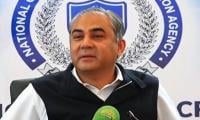
Interior Minister Mohsin Naqvi says that the head of a political party is upset because he was not given the governorship of KP. Although he said it indirectly, it is clear that he is referring to JUI-F chief Maulana Fazlur Rehman.
In such matters, there is only one way to assess the truth, and that is to look at it in the light of facts and circumstances. And when we look at this matter in that light, what Interior Minister Mohsin Naqvi is saying appears to be correct.
The first reason is that as soon as Governor's Rule was imposed, Maulana started issuing harsh statements and even said that matters had already been settled, so there was no need for an emergency. He had not said this before. If negotiations had been successful, why didn't Maulana mention it earlier? He could have at least given a hint that talks were about to succeed.
In this context, Mohsin Naqvi's point seems valid that perhaps till the last moment there was hope that the governorship would be given to a certain party, and when Governor's Rule was announced and the governorship was not given, Maulana took a hardline position and put all the blame on the government, saying that matters had been resolved and yet the government imposed an emergency.
You can call it suspicion, but this suspicion is strengthened by another thing, and that is a statement by Maulana Fazlur Rehman in which he says with a smile that no government can be formed without JUI-F, and even if it is formed, it cannot run.
This statement needs to be pondered over. It is not that JUI-F is such a popular party that no government can be formed without it. Nor does it have such public popularity that no government can run without it. JUI-F has a limited vote bank; despite the maturity of its respected leader, its vote bank remains limited. So how can one claim that no government can be formed without us and if it is formed, it cannot run?
Only one thing makes sense: when a government is formed without us, JUI-F raises such an issue that the government's feet get burned.
In the past, when Maulana was not part of the Nawaz Sharif government, he declared Nawaz Sharif guilty of a major sin on the Kargil issue.
Whichever government Maulana is not a part of, he always builds such a strong narrative against it — sometimes of being anti-Islam, sometimes declaring it guilty of a major sin, sometimes calling it an American agent.
So his thinking is perhaps that when we take such a hard stance, we create so many problems for the government that it cannot govern without us. That is, they either have to talk to us or make some deal with us, otherwise it is not possible for them to function without us. And if any government is formed without us and tries to run, then we will bring such a narrative against it that it will see stars in broad daylight.
The same point: when we connect the dots in the light of facts and circumstances, Mohsin Naqvi's point hits home and makes sense. This is not such a big mistake in conventional politics. Obviously, conventional politics is a game of power and is done for power, and there is maneuvering in it. Positions are also demanded in it, everything happens. So in this case, if Maulana Fazlur Rehman also assumed that the governorship might go to his party, there is nothing wrong with it.
But what is incomprehensible is that when you don't get your desired share in the distribution of power, your reaction should not go beyond a certain limit.
Politics is indeed about bargaining, and moving forward while keeping your interests in mind and protecting your interests is absolutely not a wrong thing. But when interests are not fulfilled, to build a case against the rulers that they are agents of so-and-so, agents of America, sellers of the nation, selling this thing of the country, playing in the hands of a certain country, committing a major sin, being enemies of Islam — such a narrative is not a moderate narrative.
And doing politics on the basis of important national issues, whether they are economic, critical minerals, or national security, is in itself an inappropriate attitude. This is what Pakistan Tehreek-e-Insaf used to do before, and if Maulana Fazlur Rehman also starts doing the same now, it will be an extremely worrying thing.