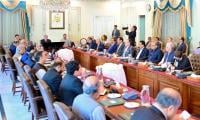
The government and the PTI appear to have reached another dead end, but neither side can afford to treat the latest breakdown in talks as the end of the road. Prime Minister Shehbaz Sharif has offered to resume dialogue if the PTI calls off its long march to Islamabad, arguing that this politics of sit-ins and marches will first damage the economy. The PTI, however, has as is usual rejected the offer, saying talks should be unconditional. The government, for its part, says its doors remain open but insists that the PTI cannot force its demands by holding the state hostage and creating political instability. The two-day negotiations collapsed largely over counterterrorism, after the federal government sought commitments from the Khyber Pakhtunkhwa government in a draft agreement. The PTI-led provincial government did not agree to the proposed framework and the long march, led by KP Chief Minister Sohail Afridi, began on October 4. There is a broader issue beneath the immediate political confrontation: whether the PTI government in KP is prepared to take political ownership of the fight against terrorism in a province that has once again become a major theatre of militancy.
The PTI’s reluctance may have a context: the experience of the Awami National Party government in KP between 2008 and 2013, when several ANP leaders, workers and family members were killed by terrorists. Political ownership of military operations can carry a heavy price, particularly in a province that has endured years of violence. But the circumstances today are vastly different. The international military presence in Afghanistan has ended, the Afghan Taliban are in power and Pakistan’s own policy towards the Taliban government has changed considerably. Islamabad now says militant groups, including the TTP, are being facilitated from Afghan territory and has itself carried out strikes inside Afghanistan. The security environment therefore cannot be approached through the same assumptions that shaped earlier debates over negotiations with militants. Imran Khan has for years opposed military operations and advocated dialogue with militant groups, including the TTP. It was during his tenure as prime minister, after the fall of Kabul in August 2021, that talks with the TTP began. CM Afridi has also made clear that he intends to follow his party founder’s policy. This is where the present dispute becomes more consequential than an argument over the wording of a government draft. If the KP government is responsible for a province facing a serious terrorist threat, it needs a clear position on how that threat is to be confronted. A comprehensive counterterrorism policy requires political ownership at the provincial level as well as federal action.
The government should resist the temptation to turn the dispute into another round of political point-scoring, just as the PTI should reconsider whether continuing this long march serves its interests at a time when the argument has increasingly become about terrorism rather than its original political demands. The two sides may disagree sharply over Imran Khan, the counterterrorism framework and the conditions for dialogue, but none of these disagreements will be resolved through a confrontation on the roads to Islamabad. Kinetic action against militants can only go so far. A durable policy also requires political consensus and a coherent public narrative about terrorism. At present, that narrative remains deeply contested. The longer this continues, the more room there is for mistrust to grow. The federal government has made clear that constitutional and political options remain available if the KP government does not comply with its counterterrorism demands. The PTI now easily risks further shrinking its political space if the confrontation continues. There is still an olive branch on the table. It would be wiser to pick it up.