ISLAMABAD/ PESHAWAR/KOHAT: Prime Minister Shehbaz Sharif on Tuesday again extended an offer of talks to the leadership of Pakistan Tehreek-e-Insaf (PTI), but with the condition that the opposition party abandon agitational politics and call off its long march.
Addressing the groundbreaking ceremony of Kashmir Chowk Underpass here, the prime minister maintained that dialogue with the PTI leadership would take place only when the party calls off its long march and ends its protests. “I still ask the PTI leadership to come to their senses and end your long marches and sit-ins. Once you end them, we will certainly sit down with you and talk so that Pakistan moves forward with mutual hard work, honesty and integrity,” he said.
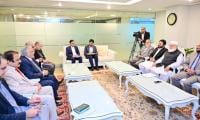
He said a joint committee comprising representatives from the Pakistan Muslim League-Nawaz (PMLN) and Pakistan Peoples Party (PPP) had held talks with the opposition, but the process stalled after the PTI demanded last-minute changes to the finalised draft, indicating that their sole objective was to sabotage the dialogue. The prime minister said that they were hopeful of a positive outcome of talks but unfortunately it could not happen as the opposition demanded last-minute changes in the draft which had already been decided.
He pointed out the PMLN and PPP unanimously decided to hold talks with the PTI leadership to convince them to end the politics of agitation and resolve all issues through talks. He said the joint committee was engaged in talks with the opposition for two nights at the Speaker’s chamber in the Parliament House with the hope that the politics of long march and sit-in would end in the country.
Shehbaz warned that continued agitation would severely harm the country’s economic growth and international standing. “This is the desire of the nation, the voice of every Pakistani,” he said.
He said the PTI had again resorted to politics of sit-ins and long marches despite the government’s sincere efforts to engage in meaningful negotiations.
He said that as a result of politics of sit-ins and long marches, the country’s economy would suffer. “There will be disruptions in your exports, your manufacturing and your imports. If your labourer or your engineer fails to reach the factory, the manufacturing site, or their office on time, whose loss is it? It is the loss of this nation, the loss of this country,” he said.
He said the government had successfully restored macroeconomic stability and was striving for growth through collective teamwork, with positive indicators reflected in rising exports, remittances and industrial production. He cautioned that undermining these hard-won achievements would amount to hostility toward the state. “We will not allow this to happen and the law will take its course. Protecting the lives and property of people is our responsibility, and we will ensure this by all means,” he said.
He said as the intersection was known as the Kashmir Chowk, the milestone would one day reach Srinagar when the people of Indian Illegally Occupied Jammu and Kashmir (IIOJK) would achieve their inalienable right to freedom.
The prime minister appreciated Interior Minister Mohsin Naqvi and his team for setting the target to complete the Kashmir Chowk project within a month.
As per the briefing, the PC-1 cost of the project was Rs1.6 billion, but the contract was awarded at Rs1.4 billion. It would feature four slip roads and would be completed in one month’s time.
The intersection currently handles 107,000 vehicles and faces congestion during peak hours, particularly during VIP movement.
In his address, Mohsin Naqvi said that the project was part of the prime minister’s vision to transform and beautify Islamabad ahead of the SCO Heads of State Summit scheduled to be held in Islamabad next year. “A lot of development and beautification of Islamabad will take place before the start of the event in less than one year,” he said. He pointed out that with the completion of the Kashmir Chowk and Expressway service road projects, the travel time between the twin cities would be slashed from the current 30 minutes down to just 16 to 18 minutes.
Mohsin Naqvi urged the public to elect those politicians who spend time working tirelessly serving the nation instead of indulging in negative politics.
Separately, Prime Minister Shehbaz met President Asif Ali Zardari, with the two leaders discussing the overall political and security situation in the country, particularly the situation arising from the PTI long march in Khyber Pakhtunkhwa, sources said.
Members of the government committee holding talks with the opposition also briefed the president and prime minister on the latest developments in the negotiations.
There were no official words with regard to the meeting between the president and prime minister, but sources said an informal meeting took place after a ceremony at the Aiwan-e-Sadr where United Nations Secretary-General António Guterres was conferred the Nishan-i-Imtiaz.
According to sources, the president and prime minister agreed that consultations would continue before taking any constitutional or legal step regarding the situation.
Meanwhile, speaking to the media in Rawalpindi alongside party Secretary General Salman Akram Raja, PTI Chairman Barrister Gohar Ali Khan said that it was entirely wrong to place the blame for the failure of talks on KP Chief Minister Sohail Afridi, noting that had there been one or two more rounds, the matter could have reached a resolution.
The offer for negotiations, he charged, was merely symbolic; no positive steps were taken beyond the mere offer itself, adding that negotiations are a continuous process and are not bound by a specific timeframe. “We did not accept dictation from anyone during the negotiations, while meetings with the PTI founder have been suspended for a year; the last meeting took place in October of last year,” he regretted.
He made it clear that they have always stood with the State of Pakistan, but despite their good intentions, they are not being allowed to meet their leader, whereas the party founder’s sisters are apolitical yet they were taken into custody.
Gohar pointed out that upon arriving at Adiala jail today (Tuesday), they were informed that the founder’s cousin, Qasim Zaman, had been detained who, he contended, is apolitical and has never made a political statement. Likewise, he claimed their MNAs and MPAs have been picked up, stressing that the cycle of arrests must stop.
Gohar claimed they engaged in negotiations with the government in good faith and sincerity, but the other side failed to demonstrate magnanimity or seriousness. He insisted none of the demands they presented were illegal. However, he acknowledged Interior Minister Mohsin Naqvi’s efforts toward the success of negotiations. “Our stance on terrorism is clear: the National Action Plan must be implemented. Khyber Pakhtunkhwa is the province most affected by terrorism, and the provincial assembly has passed a unanimous resolution on the issue,” he argued.
The issue of terrorism, he underlined, should not be addressed through press conferences or tweets; instead, a meeting of the Apex Committee should be convened.
He added that if their demands were not met, there would be no justification for stopping the long march, noting that imposing an emergency or governor’s rule would only exacerbate animosity.
Gohar noted that the arrival of a doctor from London was discussed during the negotiations.
On the occasion, PTI Secretary General Salman Akram Raja urged the government to clarify when his party had ever opposed efforts to combat terrorism, while maintaining that Khyber Pakhtunkhwa’s concerns must be factored into any counterterrorism operation.
Raja pointed out that the National Action Plan contains no provisions for drone strikes or the displacement of local populations. He affirmed that the PTI remains open to consultations on civilian displacement and drone attacks during military actions, adding that the party has already provided the government with relevant documentation on counterterrorism operations and the provincial government’s cooperation.
Addressing the prospect of resuming political dialogue with the government, Raja noted that the PTI will make a collective decision on whether to return to the negotiating table.
He firmly rejected suggestions that allowing Imran Khan access to his personal physician poses a national security concern. He expressed frustration that medical professionals from London were being called while Imran Khan’s personal doctors, who have treated him for four decades, remain barred from examining him. He stressed that PTI’s primary immediate demands focus on Khan’s health, access to medical care and permission for scheduled meetings.
Commenting on political draft proposals, Raja revealed that an initial version submitted during negotiations included a clause requiring prisoners to seek clemency. He noted that the government acknowledged the oversight and removed the provision in subsequent revisions.
He alleged that fake statements attributed to the chief minister on terrorism were actively circulating.
Raja concluded by reaffirming PTI’s backing of the National Action Plan, emphasising that while the party fully supports counterterrorism efforts, the rights and concerns of Khyber Pakhtunkhwa’s residents must remain central to any strategy.
Separately, speaking to the media outside the Islamabad High Court, Salman Akram Raja said that the long march will continue until a settlement is reached. He maintained that Imran Khan has granted full authority to opposition leaders Mehmood Achakzai and Senator Allama Nasir Abbas to conduct negotiations. “If the government wishes to hold talks, it should contact the opposition leaders; the decision regarding negotiations will rest with Mahmood Khan Achakzai and Allama Nasir Abbas,” he contended.
Meanwhile, Leader of the Opposition in the National Assembly Mehmood Khan Achakzai advised the opposition leadership to respond positively if the government initiates contact again.
Sources in the opposition said that Achakzai issued instructions to the opposition regarding negotiations, and this was conveyed to the opposition leaders through Akhunzada Hussain.
They explained that the leader of the opposition said that a positive response should be given if the government initiates contact. However, he underlined that a meeting with the founder of Pakistan Tehreek-e-Insaf must be the primary condition in the event of government contact.
Achakzai was of the opinion that the government could signal a positive step forward by releasing the sisters of jailed PTI supremo. But he insisted that a meeting with the prime minister would be meaningless without a meeting with the PTI founder. He indicated that if a meeting with the PTI founder does not take place, the option of refusing a meeting with the prime minister could be considered.
Separately, the opposition alliance Spokesman Akhunzada Hussain condemned in the strongest terms the arrest of Imran Khan’s cousin, Qasim Zaman Khan, billing it as the height of fascism, and called for his immediate release.
Akhunzada Hussain contended that the opposition alliance has demanded the immediate and unconditional release of Qasim Zaman and that attacks on the fundamental constitutional rights of citizens will not be tolerated under any circumstances.
Meanwhile, in a video statement issued to the media, former National Assembly speaker Asad Qaiser said the party’s protest was peaceful and would remain so, stressing that its workers would not take the law into their own hands. He said peaceful protest was the PTI’s constitutional and legal right and would continue until its demands were addressed.
Asad Qaiser said threats of imposing governor’s rule would not resolve the issues and warned that curtailing the constitutional powers of the provincial government would affect the parliamentary system. He urged the government to engage with the PTI on its constitutional and legal demands.
He said the PTI was ready for talks with the government despite its reservations, adding that political forces would have to sit together at the negotiating table in the national interest.
Asad Qaiser rejected what he described as attempts to portray the PTI as being against Pakistan’s development and prosperity. He said the KP people could not be denied their demand for peace and urged the federal government to fulfil its responsibility on the law & order situation in the province.
He called for the voice of a consensus jirga in the KP to be heard and for all political parties to formulate a joint strategy for peace through consultation. He said efforts were under way to convene an all-parties conference, with law and order and fundamental human rights to be its first agenda.
The PTI leader also called for the release of political prisoners and said the supremacy of the Constitution and law must be ensured. He alleged that the PTI’s mandate had been “stolen” and its fundamental constitutional rights denied.
Referring to the party’s founder Imran Khan and his family, Asad Qaiser claimed that Imran Khan, his wife, sisters and other family members were facing political cases, while more than 2,000 PTI workers were in jail. He also questioned police transfers and postings in the KP without consultation with the provincial government, saying the constitutional authority of the provincial chief executive should be respected.
Asad Qaiser questioned differences in police laws in Punjab, Sindh and KP and said the government was responsible for protecting the legal rights of ministers, MPAs and MNAs.
Meanwhile, addressing participants of the caravan on the third day of the long march at University Chowk in Kohat, Khyber Pakhtunkhwa Chief Minister Muhammad Sohail Afridi said the PTI long march would continue peacefully and according to the Constitution, declaring that he had exhausted all democratic, constitutional and legal avenues before taking to the streets.
Sohail Afridi said he had released the draft of the long march demands on social media and challenged anyone to identify even one of the seven demands as unconstitutional or unlawful. “If even one demand is proved to be unconstitutional or unlawful, I will cancel the long march immediately,” he said.
He said the demands for Imran Khan’s medical treatment, meetings with him and his release through due process of law were neither unconstitutional nor unlawful.
He alleged that attempts were being made to prevent Imran Khan from being released because of his popularity. He also expressed concern over reports about the PTI founder’s health and said that if anything happened to him, the jail administration, prime minister and other responsible officials would be held accountable.
Sohail Afridi said he had repeatedly sought a meeting with Imran Khan through the federal government, the provincial assembly and courts, but his efforts had not produced results. He claimed that three high court judges had ordered that he be allowed to meet Imran Khan, but the orders were not implemented.
He also claimed that three Supreme Court judges had ordered that Imran Khan be provided medical treatment at Shifa International Hospital but the order was not implemented.
The chief minister said that when justice was not available through the institutions concerned and all other avenues had been exhausted, the Constitution provided the right to peaceful protest. “We have started our peaceful protest from the southern region. We will register our protest peacefully and according to the Constitution,” he added.
Sohail Afridi said his government had consistently maintained that political issues should be resolved through dialogue and negotiations. He alleged that attempts were being made to compromise the interests of Pashtuns to protect political positions, saying any such an arrangement was unacceptable.
On terrorism, he said repeated military operations and drone strikes over the past 22 years had failed to eliminate the menace. He claimed that his government had a policy through which peace could be established in the province within 100 days.
Sohail Afridi announced that the long march route had been changed. Instead of proceeding directly towards Peshawar, the convoy would first move towards Khyber and then head to Peshawar. He said that once the participants decided to march towards Islamabad, no power would be able to stop them.
Meanwhile, KP Governor Faisal Karim Kundi chaired a meeting on the law & order situation in the province. The meeting was attended by Chief Secretary Shahab Ali Shah, Inspector General of Police Zulfiqar Hameed and other senior officials.
The participants briefed the governor on the overall security situation, counter-terrorism measures, public order and the latest crime situation in the province. The meeting was also informed about delays in the procurement of modern weapons, manpower-related challenges and progress on various policing projects. Officials also briefed the governor on protest activities and the planned long march in the province. Counter-Terrorism Department (CTD) officials outlined measures being taken to prevent terrorism and highlighted issues related to the procurement of modern weapons, manpower shortages and infrastructure.
The additional chief secretary gave a detailed briefing on the repatriation of Afghan refugees, informing the meeting that 45 refugee camps had been closed across the province and around 1.6 million Afghan refugees had returned to Afghanistan.
The governor stressed the need to address manpower, resource, procurement and infrastructure-related issues facing the police and CTD to further enhance their operational capabilities. “The province cannot afford complacency when terrorism, crime and law & order challenges continue to threaten our people. At a time when Khyber Pakhtunkhwa is facing a serious security challenge, the provincial government must make the safety of its people its foremost responsibility,” Kundi said after the meeting.
He added that political activity could not come at the expense of security and that every institution must focus on protecting lives and maintaining peace.
The governor stressed the need to strengthen the operational capacity of the police, CTD and other law-enforcement agencies.
Some social media reports claimed that containers had been placed along the roadside near Tarnab and Chamkani on the GT Road, where Peshawar connects with Nowshera district and onwards to Punjab, apparently to block the road. A senior police official, when approached, denied the reports and said no containers had been placed anywhere in Peshawar.
Police and government officials have already been directed not to participate in any political activity or march and warned that action would be taken against them if they did so.
Meanwhile, speaking at a press conference in Islamabad, Minister of State for Interior Talal Chaudhry said that consensus had been reached on the basic points of an agreement with the opposition, but shortly before the signing, the demands of KP CM Sohail Afridi ruined everything.
Talal Chaudhry alleged that Sohail Afridi deliberately did not let the negotiations succeed. Consensus had been reached on the basic points of the agreement, and there was confidence that a Charter of Democracy-II was about to be achieved, but shortly before the signing, the KP chief minister’s demands ruined everything.
In response to a question, Talal Chaudhry said the opposition members are obscuring the facts. The National Action Plan was approved by the PTI leader himself. The minister of state said that today in the KP, no funeral, wedding, gathering or political party’s people are safe from terrorist attacks while PTI people are roaming in groups in these very areas. “Why are they not attacked? There must be something to it.”
Separately, speaking to a private television channel, Prime Minister’s Adviser on Political Affairs Rana Sanaullah urged the PTI to call off its planned long march and return to the negotiating table, saying political differences can only be resolved through dialogue.
Sanaullah said the federal government had consistently maintained that negotiations were the most effective way to address outstanding political issues and find a workable solution. He said previous rounds of talks between the government and PTI had brought the two sides close to agreement on a draft, but the process later stalled after the PTI changed its position on the issue of terrorism.
According to Sanaullah, the government remained firm that the country’s fight against terrorism was a national challenge that required a unified response from all institutions and provinces. He said the threat had been imposed on Pakistan by its enemies and could not be dealt with through political divisions. The adviser particularly called on the KP government to adopt a united position in confronting terrorism and to stand with the federal government in efforts to counter the threat.
Sanaullah made it clear that while the government remained open to political dialogue, it would not compromise on its position on terrorism. “The federal government will not take even a single step back from its position on terrorism,” he said, stressing that negotiations remained possible but would have to take place within the framework of national security and the country’s broader interests.