PESHAWAR/ MINGORA/ISLAMABAD: Khyber Pakhtunkhwa (KP) Chief Minister (CM) Sohail Afridi said on Monday people from across Pakistan should reach Swabi, as the next phase of the movement would be announced there.
“The choice is yours: whether to accept subjugation or stand for real freedom; bow before the powerful or stand up for your rights,” he said while addressing long march participants at Jail Chowk in Karak on the second day of the march, which he had started a day earlier from Gandi Chowk in Lakki Marwat.
According to an official handout, he paid tribute to the people of Karak and the wider southern region for the warm reception accorded to the Long March.
The chief minister alleged that terrorism imposed on KP was the result of a deliberate and well-conceived plan.
Referring to criticism levelled against him on television, he said a representative of the center had labelled him “immature” on national television for standing with his people. “If standing with my people is considered immaturity, then I will continue to do so without hesitation. If loving my country is considered immaturity, I will embrace that charge again and again,” he said.
The chief minister alleged that those imposed on the country were pursuing policies that were driving it towards division and fuelling prejudice among its people. He said the situation was now slipping beyond their control, adding that even the resettled terrorists were no longer under their control. The CM said the KP government was being pressured to become complicit in policies it did not support.
“I am Imran Khan’s player. I have said ‘Absolutely Not’ to the powerful, and I will continue to stand by that position,” Sohail Afridi said. He said Imran Ahmad Khan Niazi was the only leader who commanded a nationwide following. “Imran Khan is the heartbeat of our people, and 90 per cent of the people want him,” he said.
He said Imran was the only leader capable of steering the country out of its present crises and restoring the dignity, credibility and standing of its institutions. The chief minister said the PTI founder was enduring imprisonment with courage and resolve and had refused to compromise his position for the sake of power. “Had he been motivated by a desire to return to office, he could have secured his release by signing a document,” he said, adding that Imran Khan had instead chosen to remain steadfast.
Sohail Afridi said the struggle for “real freedom” would continue alongside Imran Khan. He added that Imran Khan and his entire family were making sacrifices for the future of the people and generations to come.
The chief minister paid tribute to the soldiers who had laid down their lives in the service of Pakistan, saying their sacrifices were an integral part of the nation’s collective struggle and existence. He said he was witnessing growing public rejection of the existing system across the country, with people from Khyber to Karachi seeking to reach Islamabad.
Sohail Afridi said his government would resist any policy that ran contrary to the interests of the people. Referring to the 26th Constitutional Amendment, the chief minister alleged that the courts now awaited instructions before taking decisions, while Imran Khan continued to await his people.
Following his visit to Karak, he arrived in Lachi tehsil of Kohat, where he addressed long march participants and paid tribute to the people of Kohat for their enthusiastic reception. He said the people of Kohat would demonstrate their strength in full measure the following day and announced that the march towards Peshawar would set off from University Chowk at 3pm.
“I am a soldier of Imran Khan. The combined strength of the entire world cannot put a price on me, nor can it intimidate me,” the chief minister said. Urging participants to conserve their energy, Sohail Afridi said the struggle was a long one and required endurance and sustained mobilisation.
Meanwhile, PTI Chairman Barrister Gohar Ali Khan said on Monday that talks between the federal government and the opposition had failed to produce a final agreement, alleging that the government was unwilling to accept the opposition’s proposals and had undermined the dialogue process.
Talking to journalists here, he said five major points had been discussed during the negotiations, but no consensus could be reached on the draft proposals. He said the opposition had made sincere efforts to resolve political issues through dialogue, but the government had failed to demonstrate the required seriousness.
Barrister Gohar said the opposition had proposed a meeting between Prime Minister Shehbaz Sharif and the opposition leader and called for a joint strategy to counter terrorism involving the federal government and all four provinces. The strategy, he said, should be based on a consensus narrative and coordinated action against terrorism.
The PTI chairman accused the federal government of interfering in Khyber-Pakhtunkhwa affairs and creating obstacles for the elected provincial administration. He questioned how peace could be restored when, according to him, the chief secretary and inspector general of police were taking directions from sources other than the provincial government.
He also alleged that deputy commissioners were imposing Section 144 on the instructions of others, rather than acting on directives from the elected administration. “If a bullet is fired, all of you will be responsible,” he warned, referring to the prevailing political tensions.
Barrister Gohar further alleged that some provincial ministers, MNAs and MPAs were being “picked up” or had gone missing, and said the PTI had raised these issues during negotiations while demanding an end to what it called political victimisation.
He said the PTI was a democratic political party that had secured more than 20 million votes and criticised the arrest of PTI founder Imran Khan’s sisters and other women associated with the party, who, he said, had been sent to Kot Lakhpat Jail.
The PTI leader warned the federal government against imposing governor’s rule or an emergency in KP, saying such measures could create serious law and order problems across the country. He claimed the province was already facing a situation akin to governor’s rule without its formal imposition.
He said the PTI would neither abandon the provincial government nor dissolve the provincial assembly. However, he warned that if what he termed unconstitutional measures were taken, the party could consider a complete boycott of the National Assembly, Senate and provincial assemblies, which, he said, could lead to political deadlock and further instability.
Barrister Gohar urged the government to avoid confrontation and return to the negotiating table, saying there was still time to resolve the issues through dialogue.
Regarding the PTI’s planned march towards Islamabad, he said the protest movement would continue and the party would follow whatever route was designated by the authorities. He said the march would remain peaceful, with participants carrying Pakistani flags, and again urged the government to resume talks.
He accused the federal government of sabotaging the dialogue while simultaneously blaming the KP government for failing to cooperate with the Centre, maintaining that the PTI-led provincial administration was facing political and administrative obstacles despite being an elected government.
Separately PTI Secretary General Salman Akram Raja said on Monday the opposition had presented two key demands during negotiations with the government, but the latter was unwilling to accept them, resulting in a deadlock.
Speaking at a press conference here, he said the talks had stalled primarily over a proposed operation in KP, including a proposal to impose an emergency in certain areas of the province within 72 hours.
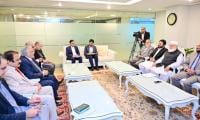
After the first round of talks, he said, the opposition negotiating committee travelled to Peshawar, where it met Chief Minister Sohail Afridi and the provincial cabinet and received a briefing on the terrorism situation.
Salman Akram presented documents of a peace jirga carrying the signatures of the PMLN, ANP and other political parties. He said the jirga, held in KP with the participation of political parties and tribal elders, had discussed solutions to local problems, stressing that decisions on the situation could not be taken from afar if peace was to be restored.
He said the opposition negotiating team wanted the jirga of political parties to be heard, arguing that ignoring its recommendations would be unwise.
The PTI leader also reiterated that a meeting with jailed PTI founder Imran Khan was essential, saying no agreement could be finalised without his involvement in the dialogue. Facilitating such a meeting, he said, was necessary to improve the country’s political environment, adding that the previous meeting between the two sides had been only a preliminary step.
Salman said the PTI had entered the negotiations with an open mind and a commitment to maintaining law and order in the country, while criticising government ministers for making what he termed trivial statements about the talks.
Meanwhile, Parliamentary Affairs Minister Tariq Fazal Chaudhry on Monday accused the KP government of failing to cooperate with the federal government in the fight against terrorism, saying its alleged disengagement was undermining the national effort against the menace.
Speaking to Geo News at Parliament House, he said the PTI-led provincial government was not standing with state institutions and that Chief Minister Sohail Afridi was not cooperating in efforts to prevent terrorism. He claimed that while three provinces were following Pakistan’s policy towards Afghanistan, KP was not doing so.
Tariq Fazal said the federal government was considering imposing an emergency in KP in view of the prevailing situation. He accused the opposition of prioritising politics and the PTI founder, Imran Khan, whom he described as a political opponent rather than a personal adversary.
He said meetings with Imran Khan had taken place in the past and that the door to political dialogue always remained open. However, he did not expect negotiations with the opposition to resume in the near future.
The minister attributed the failure of government-opposition talks to two major factors. First, he said, the opposition negotiating team lacked the authority to make decisions, as “all the authority was with the KP government”. The negotiators, he added, had themselves told the government that meeting certain demands was beyond their authority.
The second reason, he said, was a difference in priorities between the two sides. Tariq Fazal also warned that the PTI’s planned march would not be allowed to enter Islamabad “under any circumstances”.
Separately, Defence Minister Khawaja Asif asserted that the issue between the presidency and KP is “not politics but terrorism”.
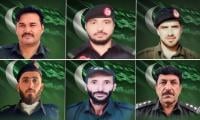
In a post on the social media platform X, Asif shared statistics from the province over the past two years, saying that approximately 6,200 terrorism incidents, 1,200 martyrdoms, and 37 suicide attacks were carried out by Afghan nationals. “Just this year, 14 suicide attacks have already occurred, the majority by Afghan nationals,” he added.
The defence czar further said that there was no shortage of funds, but corruption and weak governance in KP diminish their impact. In another related development, PTI lawmakers Monday approached the Peshawar High Court (PHC) against possible obstructions, restrictions and any alleged unlawful action by the administration during the party’s long march.
They sought directions to the authorities to ensure that the peaceful march is not obstructed and adequate security provided to its participants. The petitioners called for immediate fixation of their petition for hearing.
The petition was filed by PTI MNAs Asif Khan, Shehryar Afridi and Shandana Gulzar through their counsel, Advocate Moazam Butt. The counsel appeared before the PHC chief justice and requested that the petition be fixed for hearing the same day.
During the proceedings, the PHC chief justice asked whether any restriction had been imposed on the long march.
The counsel submitted that after an order of the Islamabad High Court, the chief secretary and inspector general of police had issued an announcement concerning the march.” So, are you aggrieved by the Islamabad High Court order?” the chief justice asked.
The counsel replied that the petitioners were not challenging the order but wanted to exercise their right to protest within the framework of the law. He said the march would pass through the constituencies of the petitioners and there was apprehension that hurdles could be created along its route.
The counsel requested the PHC to direct the relevant institutions not to create any obstruction in the way of the peaceful march. According to the petition, the PTI was holding a peaceful long march, which was initially scheduled for Sept 27 but its date was subsequently changed.
The petitioners maintained that they had no intention of taking the law into their own hands and were not seeking any relief from the court that could allow them to violate the law.
The petition stated that citizens have a constitutional right to hold peaceful protests and express their views. It requested the court to direct all relevant stakeholders to refrain from creating any unnecessary or unlawful hurdles in the way of the march and to prevent any unlawful action against the petitioners.
The petitioners alleged that the federal government was attempting to create hurdles to their peaceful march through different measures and that Islamabad had effectively been turned into a city of containers.
They said that, being members of Parliament, they were under an obligation to respect the Constitution and the rule of law and did not want to undertake any action that could raise questions about their conduct.
The petitioners requested the court to restrain the authorities from taking any unlawful action against them or the participants of the march, ensure security for the peaceful procession and refrain from creating hurdles along its route.
They sought directions against the imposition of unlawful restrictions or Section 144 during the peaceful protest, maintaining that it was the responsibility of all concerned institutions to provide adequate security arrangements and ensure that no untoward incident took place during the march.