PESHAWAR / LAHORE/ISLAMABAD: Federal Interior Minister Mohsin Naqvi and Khyber-Pakhtunkhwa Governor Faisal Karim Kundi on Sunday agreed that if President Asif Ali Zardari and Prime Minister Shehbaz Sharif deemed it necessary to impose governor’s rule or a state of emergency in the province to protect it from terrorism and destruction, the Governor’s House would play its constitutional role accordingly.
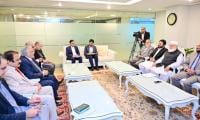
The two leaders held a meeting at the Governor’s House to discuss the province’s deteriorating law & order situation, the political environment and developments related to the ongoing long march.
According to an official handout, they expressed concern over the possibility of terrorists being facilitated in crossing security checkpoints during the march.
The statement said the provincial government’s attitude and role in counterterrorism operations during the ongoing negotiations were found to be against the interests of the people and the province.
The two office-holders alleged that the provincial government had demonstrated rigidity and irresponsibility and had repeatedly reversed its position despite an earlier consensus on resolving the issues.
They also termed the alleged use of helicopters and other government resources by Chief Minister Muhammad Sohail Afridi and provincial ministers during the long march a violation of Islamabad High Court decisions. The two sides also discussed other matters of mutual interest and held consultations on various issues.
Meanwhile, the PTI began its long march towards Islamabad from KP’s Lakki Marwat district after talks with the federal government failed to break the deadlock Saturday night.
KP Chief Minister Sohail Afridi set off from Lakki Marwat’s Gandi Chowk, saying he would announce his next course of action on Thursday, October 8, when the party’s convoy reaches Khairabad. Party workers from Bannu, Lakki Marwat, Dera Ismail Khan and surrounding districts had gathered in Lakki Marwat ahead of the march. A heavy police contingent was also deployed in the area for security.
Afridi had travelled from Peshawar to Lakki Marwat to lead the march, accompanied by PTI leaders, including Junaid Akbar.
The convoy will camp near Karak on Sunday night before participants from Karak join it on Monday. The march will then move towards Kohat, Peshawar and Charsadda over the following days.
The PTI has said it will march towards the federal capital to demand the release of its founder, Imran Khan, and seek the “supremacy of law and the Constitution”.
Addressing participants of the PTI long march at Gandi Chowk, Sohail Afridi vowed that the PTI-led provincial government would resist any attempt to impose governor’s rule or a state of emergency in the province, saying it would not accept any policy that harmed its people. He thanked the people for their participation and said the party’s negotiating team had gone to Islamabad to reduce political tensions. Afridi alleged that a “mindset that takes decisions behind closed doors” was seeking to impose another military operations-based policy on the province. “We do not accept any policy in which the Pashtuns suffer,” he said, adding that the PTI government would not accept governor’s rule or an emergency in KP.
He claimed that the provincial government had given the federal government a clear policy for restoring peace and that its implementation could bring peace to the province within 100 days. He alleged, however, that the federal government’s objective was to eliminate the PTI rather than restore peace.
Referring to the security situation, Afridi claimed that peace had prevailed during Imran Khan’s tenure because of his policies, alleging that terrorism had returned after the change of government. “They have lit this fire and we will put it out,” he said.
The chief minister urged people, particularly the youth, to participate in the political movement, saying Pakistan’s future decisions should be made by its younger generation. He predicted a large turnout in Karak and claimed that millions would join the march by the time it reached Swabi.
Afridi said the movement for “real freedom” would spread across the country and urged the PTI supporters to stand by Imran Khan and his wife who were in jail.
Earlier, the chief minister arrived in Lakki Marwat by a helicopter to lead the rally.
In a post on X, Afridi said the first phase of the march would begin from Gandi Chowk in Lakki Marwat at 1pm on Sunday, with participants from Tank, Dera Ismail Khan, South Waziristan, North Waziristan, Bannu and Lakki Marwat joining the convoy.
Separately, the KP CM on Sunday released the list of demands presented to the negotiating team, insisting that the draft contained no unconstitutional or illegal demands.
Among the proposals, the chief minister called for a formal meeting between the prime minister and opposition leaders in both houses of parliament to discuss key political, national, constitutional, legal and democratic issues. He also proposed that the prime minister constitute a joint negotiating committee comprising representatives of the government alliance, PPP and opposition parties.
On prisoners’ rights, Afridi demanded that PTI founder Imran Khan and Bushra Bibi be provided all rights guaranteed under the jail manual and applicable laws, including legal, humanitarian and medical rights, without discrimination. He called for prisoners’ meetings to be arranged strictly according to law and jail rules and not used for political or other purposes.
He further sought an end to unnecessary delays in cases involving women, elderly and sick prisoners and called for the release of political prisoners, including Yasmin Rashid and Bushra Bibi, on humanitarian grounds.
The chief minister proposed that political and national issues be resolved through consultation and negotiations, with a political negotiation committee required to submit actionable recommendations within a month. He also called for guarantees for democracy, political activity, judicial independence and press freedom.
Afridi said the PTI would call off its ongoing long march if the federal government provided written assurances on the demands.
Separately, Interior Minister Mohsin Naqvi Sunday accused KP CM Sohail Afridi of attempting to sabotage negotiations between the PTI and the federal government. Addressing a press conference in Lahore, the security czar said that 99pc of the points in the agreement had been agreed upon during the negotiations. “The agreement had been prepared,” Naqvi said, adding that he took a copy of the agreement to President Zardari.
The interior minister said that after showing the agreement to the president and returning, he learnt that several changes had been made to the draft by the KP chief minister. “Unfortunately, the KP chief minister tried to sabotage the negotiations,” Naqvi added.
Naqvi said that four drafts were prepared and amended during Saturday’s negotiations, with participants examining the details of the proposed agreement.
Naqvi said that strict legal action would be taken against those violating the law during the ongoing protest movement, warning that authorities would not allow any march on Islamabad.
The interior minister said that all those gathering for the sit-in would face a complete legal process and trial if they violated the law. He reiterated that the government had made it clear that no one would be permitted to storm the federal capital. “The long march has already begun, and we will not spare anyone who violates the law,” he said, adding that he stood by his previous statements on the matter.
Naqvi said he was keeping both the president and the prime minister fully informed about the evolving situation. He said that both leaders had instructed authorities to make dialogue efforts successful while ensuring that they remained updated on every development. “The president and the prime minister are the ultimate decision makers, and they will decide the future course of action,” he said.
He said the government had made it clear to the opposition delegation that the issue was not political but concerned terrorism. The interior minister said he had requested that the KP government be made a mandatory participant in the negotiations, adding that if CM Afridi had to make the decisions, he should have attended the talks himself.
Naqvi said the government had not asked for the postponement of the long march, although the Pakistan Peoples Party (PPP) had made such a request. He said all participants in the negotiations had shown interest in details of the discussions. “The responsibility for the failure of the negotiation lies solely with the KP chief minister.”
He warned that the KP chief minister would be responsible if any person lost their life in the PTI’s long march towards Islamabad. The security czar also said those gathering for the protest would face a complete trial, while making clear that the government would not allow any protest in Islamabad.
Naqvi’s remarks come hours after he said that the PTI-led government in KP backed out of its security commitment during the last phase of negotiations with the federal government.
In a post on X, the security czar said the provincial government had agreed to sign a written agreement and submit an implementation plan within 72 hours, covering security and counterterrorism operations. According to Naqvi, the KP government had agreed to the reconsideration of the Police Act 2026 in the light of the security situation and the need to protect security matters from political interference.
The PTI-backed government also agreed to take measures to prevent terrorists from operating freely or finding safe havens across the KP, he said.
The interior minister — who was part of the talks — said that the KP government had agreed to unequivocally condemn outlawed Tehreek-e-Taliban Pakistan (TTP) and all other terrorist groups.
According to Naqvi, the provincial government had also agreed to support national policy on Afghan refugees, including repatriation and dismantling the Afghan camps in KP.
He maintained that the KP government had also agreed to have no contact with the Afghan Taliban regime, substantial funding for counterterrorism operations and police, full provincial ownership of counterterrorism measures and stronger cooperation with the armed forces.
Naqvi said that the provincial government had also pledged to take decisions on counterterrorism in the erstwhile Fata and merged districts and implement the National Action Plan. “Last night, during the final phase of negotiations, the KP government backed out of these commitments,” he wrote in the post.
The interior minister emphasised that security must not be politicised while the “province is at war”.
Meanwhile, PTI senior leader and former National Assembly speaker Asad Qaiser said on Sunday that access to incarcerated party founder Imran Khan remained the main sticking point in talks between the government and the opposition.
In a statement, he said PTI had withdrawn all its other demands and was now seeking only the permission for its political leadership to meet Imran Khan. The government, however, had made it clear that the demand could not be included in any agreement and was not under consideration at present, he added.
“If PMLN consults Nawaz Sharif or Prime Minister Shehbaz Sharif on important matters, and PPP consults Bilawal Bhutto Zardari and Asif Ali Zardari, why cannot we consult Imran Khan, the country’s most popular political leader, before making policy decisions?” he asked.
Qaiser said “ego” was the biggest hurdle and urged all sides to set aside their differences and put Pakistan’s interests first. He said Khyber Pakhtunkhwa had faced a war-like situation for decades, resulting in destruction of businesses, difficulties for industries and widespread extortion. The closure of the Afghanistan border had further affected trade and industry in the province, he added.
He said he had presented to the negotiating committee a unanimous resolution adopted by political parties and bar associations under the KP Assembly. He called for policymaking based on the recommendations of the assembly jirga and effective implementation of the National Action Plan.
He urged the federal and provincial governments to take all political parties and stakeholders in KP into confidence and formulate a consensus strategy to address the law & order situation.
The former NA speaker also called for a review of the KP Police Act 2026 and amendments in line with police laws in Punjab, Sindh and Balochistan. He argued that if the chief executive of a province was responsible for maintaining law & order, he should also have the constitutional and administrative authority to discharge that responsibility, including an effective role in the appointment of district police officers.
Qaiser also highlighted increased allocations for the provincial police, saying the police budget had risen from Rs123 billion in 2024-25 to Rs173.8bn in 2025-26. The procurement budget, he said, had increased from Rs3bn to Rs17bn, while the development budget rose from Rs6bn to Rs30bn. He added that salaries of police constables had been brought on a par with those in Punjab, while police officers were receiving salaries equivalent to those in Balochistan. The KP inspector general of police, he said, had also stated that the provincial police were equipped with modern and advanced equipment.
On the other hand, Pakistan Peoples Party (PPP) Vice President and Parliamentary Leader in the Senate Sherry Rehman said on Sunday that the government-opposition talks with PTI collapsed after the KP government refused to sign a draft agreement on counterterrorism cooperation with the Centre. “Sorry to say, despite four drafts that we had closed with all our principals and then again reopened to accommodate PTI’s changes, talks collapsed on the KP government’s unilateral refusal to sign the afternoon’s pre-agreed draft on counterterrorism cooperation with the Centre,” she said in a post on X.
Sherry, who was a part of the government negotiating team, said terrorism was a core issue for the PPP, which had lost workers and its “iconic prime minister” Benazir Bhutto to terrorism.
She said the objective of the talks was to bring the KP government on board on all counterterrorism actions. The negotiating team had repeatedly sought the participation of the provincial government alongside senior federal PTI leadership, but neither the chief minister nor cabinet representatives attended the talks, she added.
“If they had a viable draft, they should have shown up themselves or communicated it to their committee over the two days, without constant reversals,” she said, criticising the presentation of new drafts on social media after the negotiating process had stalled.
Sherry said timing and trust were essential for building confidence in negotiations and argued that closer working relations between the provincial and federal authorities could have helped make progress.
She alleged that the KP government began “dictating terms” after 8:30pm when, according to her, all but the final agreements had been reached, describing the subsequent developments as a “reckless squandering” of an opportunity to initiate political confidence-building measures and promote stability.
The PPP leader said she had never witnessed in her 25 years in parliament such a missed opportunity to reduce political tensions. She thanked President Asif Ali Zardari and PPP Chairman Bilawal Bhutto Zardari for creating space for dialogue, as well as Prime Minister Shehbaz Sharif, National Assembly Speaker Sardar Ayaz Sadiq, Interior Minister Mohsin Naqvi and members of the negotiating teams for remaining engaged in the process.
“Even before Sunday break of dawn, we did not walk away or close the doors. We waited until they stopped coming back. We really went more than halfway. The rest could have followed,” she said.
Also, the PTI on Sunday expressed regret over the deadlock in government-opposition talks, saying its demand for immediate access to jailed party founder Imran Khan remained the principal stumbling block.
The party said the joint PTI-Tehreek Tahaffuz Aiyeen-e-Pakistan (TTAP) negotiating team and the government panel ended their talks without substantive progress despite efforts to address political stability, democratic and constitutional issues, Imran Khan’s access, his health and medical treatment and the worsening security situation in Khyber Pakhtunkhwa and other parts of the country.
PTI said it remained willing to pursue political dialogue, constitutional processes and meaningful consultation to address the country’s political and security challenges. However, it maintained that serious negotiations required flexibility, mutual confidence and a willingness to translate discussions into practical steps.
The party said its negotiating team had offered to set aside its other demands if the government agreed to allow its leadership access to Imran Khan, but the government declined to include the demand in the proposed agreement.
PTI argued that consultation with its chairman on major political and national issues was essential, just as other political parties consulted their leaders. It said restricting such access limited the scope for meaningful political engagement.
On KP’s security situation, the PTI said the government had sought the provincial government’s unconditional support for federal counterterrorism measures and emergency steps in the merged districts and adjoining areas. The party reiterated its condemnation of terrorism and paid tribute to security personnel and civilians who had lost their lives in the fight against militancy.
It said the people of KP had borne the brunt of terrorism through loss of life, destruction of property and businesses, insecurity and displacement. Any counterterrorism strategy, it maintained, should therefore combine firm action against militants with protection of civilians and consideration of local realities.
PTI proposed that authorised representatives of the federal and KP governments meet within 72 hours to formulate a mutually agreed counterterrorism and peace strategy. It also called for consultations with political parties represented in the KP Assembly, elected representatives, tribal elders and other stakeholders.
The party rejected criticism of KP Chief Minister Muhammad Sohail Afridi’s position, saying that access to Imran Khan could have enabled him to consult the PTI founder on security and counterterrorism policy and potentially helped bridge the differences.
PTI also raised Imran Khan’s health, saying its negotiators had sought his immediate access, transfer to Shifa International Hospital and the formation of a medical board, including his personal physician. According to the party, the government agreed only to restore meetings with his family and lawyers from Tuesday.
While welcoming the restoration of those meetings, the PTI said they could not substitute for proper medical examination and treatment.
Responding to a subsequent press conference by federal ministers, the party urged the government to address the substantive issues that had prevented progress and explain its refusal to allow immediate access to Imran Khan, accommodate the proposed medical measures and adopt a broader consultative approach to developing a sustainable security strategy for KP.
Separately, PTI Secretary General Salman Akram Raja claimed on Sunday that the primary reason for the failure of overnight talks was the federal government’s insistence that all anti-terrorism actions it unilaterally initiated in KP must be owned by the provincial government.
In a statement posted on X, Raja said the PTI-TTAP team had stood firm on its principled position that anti-terrorism actions in KP would be based on agreement between the federal and KP governments and framed on the basis of consultation with, and the buy-in of, all political parties represented in the KP Assembly. He said the government team found this unacceptable and demanded instead that any unilaterally initiated federal actions be owned by the provincial government.
Raja said the PTI had zero tolerance for terrorism and was committed to rooting it out, but also maintained a clear position against collateral damage in the form of innocent lives and internal displacement of local populations. He said policies and actions aimed at fighting terrorism must have the support of the local population and be based on ground intelligence.
He said the wisdom provided by the jirga held in the KP Assembly — involving all political and tribal notables of the province, including from the merged districts — must be heeded, but this too was not acceptable to the federal government.
Senate Opposition Leader Allama Raja Nasir Abbas said differences remained over a meeting with jailed PTI founder Imran Khan, access to his personal doctor and clarity over military operations in areas hosting internally displaced persons. He said the government had indicated it was not currently in a position to arrange a meeting with Khan, though meetings between his sisters and lawyers would be allowed.