KARACHI: Pakistan Peoples Party (PPP) Chairman Bilawal Bhutto Zardari on Saturday urged the Pakistan Tehreek-e-Insaf (PTI) to postpone its long march and engage with the federal government to evolve a political agreement for jointly confronting terrorism, warning that continued deterioration of the security situation in Khyber Pakhtunkhwa could leave the Centre with no option but to impose governor’s rule.
Addressing the inauguration ceremony of Treatment Plant-I of the Greater Karachi Sewerage Plan at Haroonabad, Gutter Baghicha, he disclosed that the federal government had been considering imposing governor’s rule or taking emergency measures in Khyber Pakhtunkhwa, but the PPP had advised it that a political solution should first be pursued.
Bilawal said the PPP had subsequently sought permission from the federal government to engage with the PTI, stressing that all political parties should play their role in persuading the PTI to end its protest and work with the Centre to tackle terrorism.
“Governor’s rule and emergency are constitutional options, and the federal government was prepared for them. But the PPP advised that every effort should first be made to find a political solution,” he said. He urged the PTI to separate political issues from the question of terrorism and to recognise that the two matters required different approaches. “PTI should be convinced to accept that its long march has achieved its objective and end it,” he said, adding that the PTI should then sit with the federal government and reach an agreement on combating terrorism.
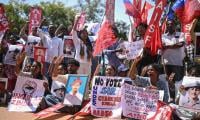
Bilawal said Islamabad had witnessed considerable political turmoil and remained effectively closed for the past 10 days because of the ongoing protest activity. He cautioned that the situation in Khyber Pakhtunkhwa could not be treated as an isolated provincial matter. “If there is an illness in Khyber Pakhtunkhwa, Karachi develops a cough,” he remarked, explaining that any escalation in terrorism in KP would inevitably affect Sindh and other parts of the country. He said terrorism was a “red line” for the PPP and stressed that the threat should not be viewed through a political lens.
“Everyone must sit together and formulate a plan to deal with terrorism,” he said, adding that the security situation in Khyber Pakhtunkhwa and Balochistan was before everyone, and any further escalation of unrest would have repercussions across all the provinces. Bilawal said terrorism was currently taking place in KP and Balochistan, but its consequences were already being felt in Sindh. He called for a collective national response rather than political confrontation. “We all have to fight terrorism together,” he said, adding that attacks were also being carried out from Afghanistan and India was behind them. The PPP chairman said the KP government appeared to be more focused on protest politics while terrorism was increasing in the province. He warned that if the situation could not be brought under control, the federal government might ultimately be compelled to impose governor’s rule. He said the PTI and the federal government needed to negotiate an agreement under which the KP government could work with the Centre to combat terrorism. “I hope all political parties sitting in Islamabad will find a political solution so that we do not have to confront terrorism through an emergency,” he said.
Turning to Karachi’s longstanding civic and infrastructure problems, Bilawal criticised what he described as the federal government’s unequal treatment of the country’s largest city and economic hub. He said people sitting in the federal government frequently commented on Karachi’s problems, including its water shortage, without recognising the reasons behind the city’s inadequate supply. “People sitting in the federal government comment on Karachi, but Karachi is treated as a stepchild,” he said. He maintained that Sindh had not been receiving its due share of water under the Water Accord and said the province’s entitlement from the Indus River had never been fully provided in accordance with the agreement. “Our 80 per cent water is supposed to come from the Indus River, but Sindh has not received its share according to the agreement to this day,” he said.
He said the provincial government was continuing efforts to address Karachi’s water shortages, particularly in underserved areas. Measures would also be taken to supply water to the people of Keamari, while an additional 10 million gallons of water would be provided to Lyari, he added. He also criticised the federal government’s failure to address electricity and gas shortages in Sindh, especially Karachi, despite the province being a major producer of gas.
He said the federal government neither provided Sindh with its due resources nor addressed its legitimate demands, while federal officials sometimes appeared to take the province’s grievances not seriously.
“We are still waiting for the K-IV project,” he said, adding that he had also raised the matter with Prime Minister Shehbaz Sharif. Referring to the federal government’s frequently cited “Shehbaz Speed”, Bilawal said, “We have heard a lot about Shehbaz Speed, but unfortunately we are still waiting.”
He also called for the construction of a motorway linking Sukkur and Hyderabad, questioning why motorway projects could be undertaken elsewhere in the country but not in Sindh.
Nevertheless, he said the PPP would continue listening to complaints from federal ministers while carrying on with its own development work.