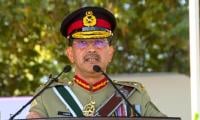
ISLAMABAD/ADEN/DUBAI: Prime Minister Shehbaz Sharif in a telephonic conversation with Saudi Crown Prince and Prime Minister Mohammed bin Salman on Sunday said that he, along with Field Marshal Syed Asim Munir and Deputy Prime Minister Mohammad Ishaq Dar, would continue their efforts for defusing tensions and bringing peace in the region.
The Prime Minister lauded the Saudi Crown Prince for his wise and sagacious leadership throughout the crisis. “During their warm and most cordial conversation, the Prime Minister reiterated Pakistan’s strong condemnation of the recent attacks by Houthis on Saudi Arabia’s civilian and economic infrastructure”, the PM Office said in a statement.
While expressing complete solidarity with the Saudi leadership as well as the brotherly people of Saudi Arabia, the Prime Minister stated that the recent Houthi actions threatened regional peace and security and could further disrupt the global economy and energy supplies.
The Prime Minister also availed himself of this occasion to convey his warm wishes and respectful regards for the Custodian of the Two Holy Mosques King Salman bin Abdulaziz Al Saud.
Crown Prince Mohammed bin Salman appreciated Pakistan for its steadfast support to the Kingdom of Saudi Arabia as well as its efforts for peace and stability in the region.
The two leaders agreed to continue to remain in close contact, and looked forward to meeting each other at an early date. “I was pleased to speak with my dear brother, His Royal Highness Crown Prince Mohammed bin Salman, this afternoon,” Prime Minister Shehbaz Sharif said on X.
He said that he reiterated Pakistan’s strongest condemnation of the recent Houthi attacks targeting civilian and economic infrastructure in the Kingdom, and conveyed complete solidarity with the Saudi leadership and Saudi brothers and sisters.
“Such reckless actions threaten regional peace and stability, with serious consequences for the global economy and energy security”, he said.
“I also deeply appreciate wise and sagacious leadership of the Crown Prince during these challenging times. Field Marshal Syed Asim Munir, DPM Ishaq Dar and I will continue our efforts to help defuse tensions and advance peace and stability in the region”, the Prime Minister said.
Meanwhile, Oman has announced the postponement of a meeting Monday (today) between Iran and Gulf countries on the Strait of Hormuz, the major flashpoint in the Middle East war.
Iran’s foreign ministry had said there would be a meeting hosted by Oman where the future of the strait, vital for global oil and gas flows, would be negotiated.
Tehran said Iraq and Gulf countries would take part, without specifying which states, but no country in the region had confirmed its participation while Bahrain ruled out attending.
“It has been decided to postpone to a later date the regional meeting that was to be held on Monday in Salalah, in order to create conditions conducive to a constructive dialogue,” the Oman News Agency said on Sunday.
Omani Foreign Minister Badr Albusaidi said on X that “we remain determined to promote dialogue that contributes to stability and lasting cooperation in our region”.
A meeting in Oman between Iran and Gulf Arab states, scheduled for Monday to discuss possible agreements on the Strait of Hormuz, was postponed at the request of some regional countries in a decision jointly made by Tehran and Muscat, Fars news agency reported, citing an Iranian foreign ministry official.
US President Donald Trump said earlier on Sunday he does not “care” about a proposed meeting between Iran and Gulf states to discuss the Strait of Hormuz amid the ongoing American conflict with Tehran. “I don’t care. That’s up to them,” the US leader told reporters during a visit to Ireland when asked about Monday’s planned meeting in Oman.
New strikes on Saudi Arabia and on ships in the Gulf tested nerves in the Middle East on Sunday, after an attack on a Saudi oil pipeline and an advance by Yemen’s Houthis threatened to worsen the wartime disruption to global energy supplies.
Oil traders were expecting prices to rise again when markets reopen on Monday (today), following the weekend developments that jeopardise supplies from the world’s biggest exporter, Saudi Arabia.
In the latest incidents in the Gulf, the British maritime security agency UKMTO said on Sunday that a vessel had been struck by a projectile as it moved through the Strait of Hormuz, causing a fire and forcing the crew to be evacuated. Iran, for its part, said one person was killed and four crew wounded aboard an Iranian commercial vessel struck off its coast.
In Saudi Arabia, state media released video of damage to homes and a mosque from the purported latest cross-border attack by the Houthis, in Jazan province in the south. The Houthis claimed separately to have struck a Saudi military base in a neighbouring province.
Southern Saudi cities have experienced regular alerts since last week, culminating in drone strikes on Friday that knocked out the 1,200-km (745-mile) east-west pipeline across the Arabian Peninsula that has served as the main route for global supplies of Middle East oil bypassing the Strait of Hormuz.
That same day, the Houthis captured Perim Island, which lies in the middle of the Bab El-Mandeb, the “Gate of Tears” strait that controls the mouth of the Red Sea.
Oil prices surged above $100 last week for the first time since July. The politically sensitive retail price of diesel fuel in the United States rose on Sunday to another all-time high above $6.20 a gallon.
Traders and Saudi oil buyers told Reuters on Sunday that Riyadh has enough oil stored at its Red Sea port of Yanbu to maintain exports for just five to seven days if the pipeline struck on Friday remains shut.
After that, as much as 4 per cent of global oil supply could be jeopardised, on top of the millions of barrels a day already lost to the disruption to traffic through the Strait of Hormuz.
Houthi media reported on Sunday that Saudi Arabia had carried out two strikes on Saada, in the north of Yemen, a stronghold for the pro-Iran group.
The Almasirah TV channel also reported artillery fire in the border district of Monabbih, in the same province. Soon after, Saudi Arabia’s civil defence agency sent alerts warning of potential attacks in two regions bordering Yemen.
The alerts, which were for the city of Abha and the region around Khamis Mushait, were quickly lifted.
Iranian President Masoud Pezeshkian said on Sunday that he had held good talks with Abu Dhabi Crown Prince Sheikh Khaled bin Mohamed bin Zayed Al Nahyan in New Delhi on the sidelines of the BRICS leaders’ summit, adding that the two sides had agreed to put the past behind them.
President Donald Trump suggested on Sunday the United States could stay in Iran and “keep the oil”, drawing a parallel with a US push to take control of a fifth of Venezuela’s vast oil reserves.
On a trip to Ireland for meetings and to watch golf, he reiterated that he still expected the Iran war to end this year, possibly just after midterm elections due in the United States in November.
An Iranian commercial vessel was struck off southern Iran early on Sunday, killing one person and wounding three others, Iranian state media reported, citing the governor of Qeshm County.
Flaring fighting between government forces and Iran-backed Houthi rebels in Yemen has displaced nearly 86,000 people, the United Nations said Sunday, with the number surging by 10,000 from a day earlier.
Iraqi authorities announced on Sunday a timeline to reopen three crossings with Iran, a day after closing them following a drone attack originating from their shared border on a Saudi pipeline.