Sindh Minister for Education Syed Sardar Ali Shah, responding to criticism regarding Sindh’s unity, provincial autonomy and the Education Department, has said that Sindh’s political sentiments and the education sector should not be viewed in isolation from one another.
He stressed that Sindh does not seek confrontation with anyone, but the sentiments of the people of Sindh must not be hurt.
“The people of Sindh are guarantors of Pakistan’s survival. We are part of Pakistan under the Pakistan Resolution, and it is essential to respect the opinion and sentiments of the people of Sindh,” he said.
Addressing a joint press conference with Sindh Minister Jam Khan Shoro and Sindh government spokesperson Saadia Javed at Committee Room No. 1 of the Sindh Assembly, the education minister said that two days earlier, a prominent journalist had linked data related to the Education Department with a political statement, despite the two matters having completely different backgrounds and contexts. He said the data presented regarding the Education Department was inaccurate and was subsequently corrected following a public response.
Shah said Faryal Talpur’s remarks regarding the unity of Sindh were made in the context of a political and emotional issue and represented the collective voice of people speaking different languages across Sindh. He said linking those remarks with incorrect data concerning the Education Department was not appropriate for a professional journalist.
He appreciated Hamid Mir for correcting the data, saying, “I appreciate the correction of the data.” However, he added that he had expected a formal apology as the inaccurate information had also hurt the sentiments of the people of Sindh.
Shah said the education sector was extremely important and its challenges should not be viewed merely as an issue of Sindh or any single province. Pakistan’s education system has faced various complexities since 1947, while the issue of out-of-school children is a challenge shared by the entire country.
He said that whenever figures regarding out-of-school children in Sindh are discussed, figures from Punjab, Khyber Pakhtunkhwa and other provinces should also be presented. “It is not appropriate to hold Sindh alone responsible for the country’s educational challenges,” he said.
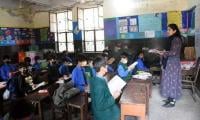
He added that, thousands of schools in Sindh were completely or partially damaged during the floods of 2020 and 2022, leaving many unable to continue the teaching process. Despite the scale of the destruction, he said, educational activities in Sindh did not come to a complete halt, and children in several areas continue to pursue their education despite significant difficulties.
He said the Sindh government recruited 97,000 teachers in a single phase, providing opportunities to young people across the province, particularly female candidates, through merit and transparency. He described the employment of such a large number of young people as a significant achievement and said that people like Hamid Mir should also highlight such positive developments.
“Children in Sindh are looking towards Islamabad. From Karachi, we are doing as much as we can. The children of Sindh are also the children of Pakistan, and Islamabad should play a serious role in this regard,” he said.