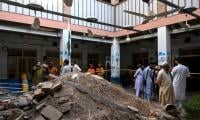
ALPURI: The bodies of the last two coalminers who lost their lives in the tragic colliery disaster in the Spin Karez (Sorenj) area on the outskirts of Quetta in Balochistan were brought to their native Shangla district on Sunday.
The bodies were transported by ambulance and received by district administration officials, police personnel, Rescue 1122 teams, local elders and relatives before being handed over to their bereaved families.
A large number of relatives, local residents, political leaders, social activists and religious figures gathered to receive the deceased miners. Funeral prayers for the deceased were attended by mourners from different parts of Shangla.
The victims were later laid to rest in their ancestral graveyards amid tears, prayers and emotional farewells. The burial of the final two victims marked the completion of funeral rites for all 34 miners who lost their lives in the coal mine disaster, bringing an end to days of uncertainty for the affected families.
The tragedy occurred at a privately operated coal mine in the Spin Karez (Sorenj) area near Quetta, where poisonous methane and other toxic gases reportedly accumulated inside the mine, trapping workers underground.
The disaster claimed the lives of 34 miners, many of whom belonged to Shangla district in Khyber Pakhtunkhwa and had travelled to Balochistan in search of employment to support their families.
Rescue teams continued a difficult operation for several days under extremely hazardous conditions. One by one, the bodies of the trapped miners were recovered from deep inside the mine.
The recovery of the final two bodies on Saturday officially concluded the rescue operation, allowing the victims to be transported to their hometowns for burial.
With the arrival of the last two bodies in Shangla, all the victims of the tragedy have now been laid to rest.
The disaster has once again cast a shadow of grief over the district, where coal mining remains one of the primary sources of livelihood for hundreds of families despite its hazardous working conditions.
Condolence visits continued across various parts of Shangla as political leaders, government officials, social workers and members of civil society expressed solidarity with the bereaved families.
Quran Khawnai and collective prayers were also offered in mosques for the departed souls.
The affected families demanded an impartial, transparent and high-level investigation into the tragedy, insisting that those responsible be brought to justice.
They alleged that negligence, poor enforcement of safety regulations and the failure of the relevant authorities to ensure proper inspection of coal mines had repeatedly resulted in the loss of precious human lives.
The bereaved families urged the federal and provincial governments to provide immediate and adequate financial compensation to the heirs of the deceased miners.
They called for government employment opportunities for one member of each affected family, educational support for the victims’ children, and long-term welfare assistance for widows and other dependents.
The families stressed that unless comprehensive safety measures are enforced in accordance with international mining standards, similar tragedies will continue to claim innocent lives.
They urged the authorities to ensure the strict implementation of mine safety regulations, regular inspections, proper ventilation systems, gas detection equipment and effective emergency rescue mechanisms at coalmines across the country to prevent future disasters.