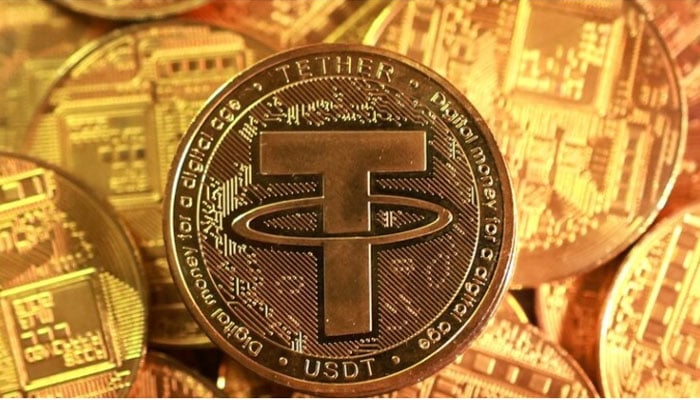
The global stablecoin market now exceeds $320 billion. Ninety-nine percent of it is denominated in a single currency: the US dollar. Not the euro, despite the eurozone’s 19 trillion euro economy. Not the yuan, despite Beijing’s sustained push for renminbi internationalisation.
The US dollar: distributed frictionlessly across blockchain rails and accessible to a 22-year-old in Lahore, Lagos or Jakarta before she has ever even opened a bank account.
This is the most consequential monetary development of the last decade, and most finance ministries in the developing world have yet to fully reckon with its implications.
USDT alone accounts for approximately 60 per cent (around $189 billion) of the total market. USDC represents roughly 26 per cent (about $76 billion). Together they process tens of trillions in annual on-chain volume. Euro-denominated stablecoins, by contrast, remain below one billion euros: less than one per cent of the market. For emerging-market central banks, the real disruption is not cryptocurrency volatility. It is the rise of price-stable dollar proxies that any citizen can access within seconds, entirely outside the domestic banking system. The dollar has not conquered digital finance through government decree or multilateral agreement. It has done so through private issuers and permissionless infrastructure.
For Pakistan, this digital dollarisation is already an active economic reality. As the state battles capital flight and rupee volatility, thousands of freelancers and savers in Karachi and Lahore are bypassing legacy banks to hold USDT. While Islamabad still debates frameworks for crypto based cross-border payments, the market has already voted: street-level demand for dollar proxies has outpaced the state’s capacity for control.
Washington moved to formalise its position. The GENIUS Act, passed in 2025, sought to codify dollar dominance in the stablecoin market by requiring issuers to hold high-quality reserves, preferably US Treasury securities, thereby bringing large pools of digital-dollar liquidity into the regulatory perimeter.
The largest player, however, remained largely unmoved. Tether (USDT), with on-chain transaction volumes that rival Visa, is incorporated offshore and has shown no interest in US domicile. Circle, by contrast, is incorporated in Delaware, listed on the NYSE, and licensed across 46 US states. Circle is everything Washington wanted. Circle is also only 26 per cent of the market.
The GENIUS Act produced a revealing paradox: by mandating strong reserves, it ensured that even offshore issuers would continue holding substantial US government debt. Washington secured the monetary transmission benefits it sought, but it did not gain full supervisory control over the dominant player. The policy succeeded economically while delivering only partial regulatory victory.
This offers an important lesson for developing-world policymakers. Even the world’s most powerful regulator could not achieve total control. For countries with far more limited leverage, the structural challenge is sharper: the entities whose products most influence their citizens’ monetary behaviour often sit beyond their jurisdiction.
The deeper question for finance ministries from Islamabad to Nairobi is harder: how do you compete with a parallel monetary system you do not control? The honest answer is that full traditional sovereignty in this domain is no longer realistic. No government today can reliably prevent its citizens from accessing USDT. The dollar does not need your permission to circulate in your economy – and stablecoins have made that reality structurally permanent.
Yet this does not mean policymakers are powerless.
Emerging-market regulators still have practical levers. The key is jurisdiction by contact: while Tether sits offshore, every domestic bank, exchange, or payment provider that touches it does not. License and supervise those gateways. Enforce AML compliance and consumer protection at the point where digital dollars meet the formal economy. Require licensed operators to disclose stablecoin exposures and concentration risks that you cannot audit Tether’s reserves, but you can build a national systemic picture through the entities you do control. And legislate liability rules for sanctions exposure and platform failures before they happen, not after. This is not Westphalian sovereignty but rather a pragmatic operating framework for a world where dollar stablecoins are already embedded.
For Pakistan specifically, this is not abstract. Remittances reach almost $40 billion annually and the rupee faces persistent pressure, the quiet shift towards dollar stablecoins is already underway, often through informal channels. Ignoring this trend risks driving more activity underground while losing oversight and potential revenue. Conversely, thoughtful engagement could position Pakistan as a more competitive player in regional fintech and cross-border payments.
The jurisdictions responding most effectively have accepted this gap, between ideal and achievable. The UAE built a VASP licensing regime and sandbox infrastructure. Singapore moved early on stablecoin classification. The EU’s MiCA framework, whatever its imperfections, created legal certainty. None of them controls Tether. All of them built accountability around it. Countries still debating whether to engage are not preserving sovereignty; they are ceding it by default.
Washington wrote the GENIUS Act to control the stablecoin market. It discovered that control, even for the world’s most powerful regulatory jurisdiction, is only partial. For everyone else, partial is probably the best available outcome. The question is whether to build toward it deliberately, or to arrive there by accident; having ceded by default what could have been preserved through proactive regulation.
The writer is an Islamabad-based lawyer and Strategic Legal Counsel at HP FKM. She can be reached at: [email protected]