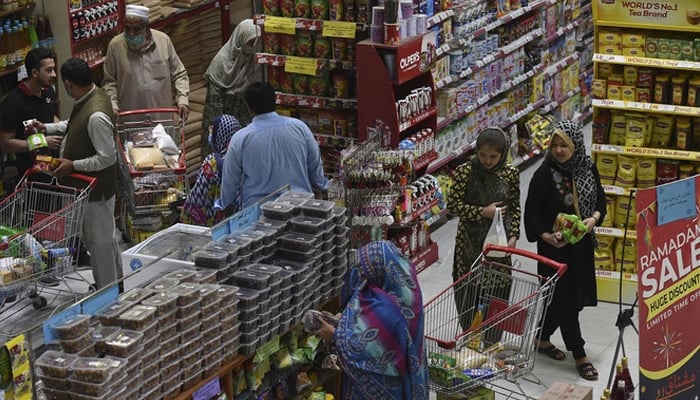
LAHORE: The friction between the Federal Board of Revenue (FBR) and the retail trade sector is one of the most stubborn deadlocks in the country’s economic management. Previous mandatory schemes stumbled due to massive pushback from powerful traders and political compromises.
But this year the government has pivoted its strategy, and the IMF’s oversight is far stricter, meaning it is unlikely to be a total non-starter. Recognising that coercive, monthly, or heavily bureaucratic models were failing, the government has introduced a redesigned approach tailored to address previous grievances.
Instead of complex monthly calculations that invite audit fears, small traders and shopkeepers (with an annual turnover up to Rs200 million) can opt for a fixed 1.0 per cent tax on total annual sales, with a minimum floor of Rs25000 per year.
Upon registering via a simple one-page form available in local languages, shopkeepers receive a physical plaque with a QR code to display. If genuine, tax inspectors are barred from entering the shop for inspections or audits, and the business is exempt from installing complex Point-of-Sale (POS) software.
For traders who refuse both the regular tax net and this simplified scheme, the government is introducing heavy, compounding non-compliance fines, starting at Rs10,000 for the first month and scaling up to Rs50,000 by the third month.
Unlike previous years, the government has some structural advantages. Pakistan is under a strict $7 billion IMF programme that explicitly demands widening the tax base beyond the over-taxed salaried class and corporate sector. The state simply lacks the fiscal space to roll back these measures entirely without derailing the loan.
By eliminating the threat of arbitrary tax-inspector visits, which traders historically feared due to bribery and harassment, the biggest psychological barrier to entering the tax net has been removed. The formal corporate sector, salaried professionals, and industrial bodies are aggressively lobbying the government to “widen the net before deepening it”, reducing the political cover traders usually enjoy.
But the chances of its failure cannot be completely ruled out as major retail unions in commercial hubs like Karachi, Lahore, and Faisalabad possess immense organizational power to show street power and go on shutter-down strikes. If they call a prolonged shutter-down strike, the political cost often forces governments to back down.
Moreover the FBR lacks independent data verification tools. Without mandatory POS integration for these businesses, a shop making Rs150 million could easily claim they only made Rs5 million, paying the bare minimum.
Tier-1 and branded retailers are barred from this simplified scheme and must integrate into the standard Sales Tax regime. They are the ones leading the charge to resist, and they have the capital to fund extensive legal battles and strikes.
If direct retail taxation remains a political minefield, economists and policy analysts suggest several alternative, indirect routes to document and tax the retail sector without triggering street protests. Instead of waiting for a shopkeeper to file a return, the government can leverage electricity connections. Commercial power meters in wholesale markets and premium retail areas can be heavily surcharged based on consumption tiers. This acts as an indirect tax on business activity that is virtually impossible to evade without disconnecting the power.
Instead of chasing 3.5 million individual retail shops, the FBR can tighten the screws on the distribution choke points, the large manufacturers, importers and major wholesalers who supply the retail markets. By forcing full documentation at the supply stage and imposing high withholding taxes on sales to unregistered distributors/retailers, the cost of remaining informal becomes prohibitively expensive for the shopkeeper.
Currently, cash is king in retail, allowing transactions to remain invisible. An alternative strategy involves aggressively pushing digital transactions by lowering the sales tax rate significantly (eg, from 18 per cent down to 5.0 per cent) for any customer paying via debit card, mobile wallet, or QR code. Or imposing higher withholding taxes on cash withdrawals above a certain daily limit for commercial bank accounts. When consumers start demanding digital payment options to save money, retailers are forced to formalise their banking channels, leaving a paper trail the FBR can eventually tax.