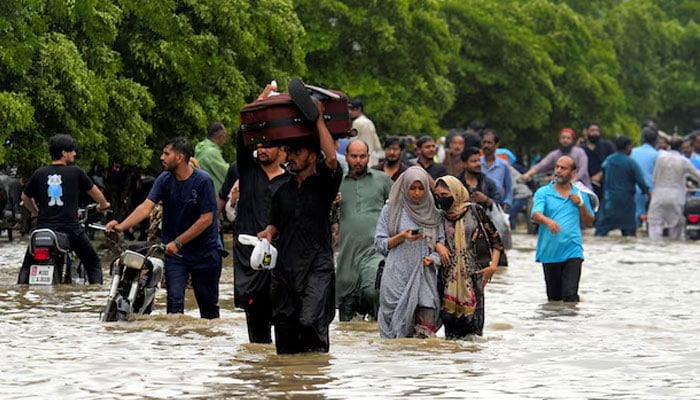
Pakistan is highly vulnerable to climate change and its impacts; there is no doubt. It requires serious debate, policy, and implementation frameworks. Unfortunately, the debate and policy are stuck between the hawks and advocates, and sane voices are very few. The climate hawks are portraying a doomsday scenario and trying to convince everyone doomsday is approaching. In their opinion, they are serving the nation. In their opinion, it will bring funding for Pakistan.
However, building a doomsday rhetoric is not a wise policy or strategy, as no one heeds it. Every country is busy sorting out its own climate change-related problems. Low economic growth and global debt crisis further exacerbate the situation. Pakistan has firsthand experience after the 2022 floods. Despite Pakistan experiencing worst flood in human history, only a few countries provided a few hundred million dollars in aid.
Therefore, Pakistan needs to move beyond this rhetoric, as it is not helping. Rather, the doomsday scenarios impact potential investment. Potential investors start to believe that their investment will be exposed to climate impacts, sooner or later. They fear their investment can be wiped out at any time. Moreover, investors believe during disasters, there would be challenges for labour force due to displacement of workers or their families, or because workers have to care for them. On the other hand, they may have to invest in labour health due to high prevalence of disease during disasters.
Therefore, Pakistan needs to adopt innovative approaches to address its climate-related vulnerabilities and present solutions. Pakistan should stop seeking charity and avoid making climate vulnerability a source of doomsday scenarios. Instead, it should try to make it an opportunity to attract investment. How? Pakistan should develop a model of Economy of Adaptation and Resilience (EAR) and support it with a concrete implementation framework.
The EAR must be implemented in a stepwise manner. The first phase should be to develop a comprehensive Economic Framework of Adaptation and Resilience (EFAR). Map the climate-vulnerable and non-vulnerable areas. Mapping should serve as a guide for devising investment plans. It will also assist government in developing climate-resilient and compatible economic infrastructure. It will also be helpful in developing building and infrastructure codes that will enable investors to build climate-resilient infrastructure.
Launch insurance programmes for economic infrastructure, especially in climate-vulnerable areas. Pakistan can also invite international insurers to join this effort. This will build investor confidence in the country despite its vulnerabilities. Issue the special adaptation and resilience credits and bonds, similar to carbon credits.
The EFAR should pay special attention to agriculture, given its contributions to GDP (23.5pc) and employment (37pc) as well as its role in supplying raw materials to industries. It is also required because government is working to attract investment in agriculture. However, agriculture is highly vulnerable to climate shocks, including changes in water availability and timing, shifts in growing seasons, and heat waves. Against this backdrop, attracting investors would be difficult without targeted programmes and initiatives for agricultural sector.
However, none of these objectives can be achieved without developing high-quality human capital that can adapt to change and has the skills required to work in a climate-vulnerable environment. For that purpose, the state will have to invest in education and health sectors, which are highly vulnerable to climate change. Hence, there is a need to develop models that make minimal contributions to climate change, are resilient to vulnerabilities, and support development of high-quality human capital with climate sensitivity.
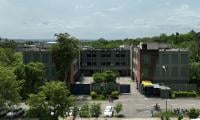
The State may consider establishing a Climate-Compatible Education System (CCES) with vision of promoting harmony between humans and the planet. The CCES should produce high-quality, climate-sensitive human capital. The education system’s infrastructure should be resilient to potential climate change impacts. It should be designed to accommodate future changes. For example, infrastructure should be able to withstand thermal shocks and require minimal energy for heating or cooling. Therefore, materials used in the construction of educational institutions must be resilient to floods, heat waves, and other extreme events. The CCES should also contribute to building community resilience. The institutes should be built in locations that can serve as temporary shelters, especially for women and children during disasters.
The CCES should promote, rather than make it obligatory, use of renewable energy resources such as solar, wind, and biogas for lighting, cooling, and heating. Moreover, building designs must reduce energy use and minimise GHG emissions. The transport system can be shifted to renewable energy sources. Develop a curriculum that highlights the causes of climate change, its impacts, and the role each member of society can play, irrespective of age. It will help create green generations.
Pakistan can tag all the above-discussed areas with financial incentives, such as issuing carbon credits and introducing innovative adaptation and resilience credits. In this way, the State can make the CCES self-sustaining.
For the health sector, government should immediately set up Climate and Health Research Centre. It should be a joint venture of Ministry of Climate Change and Ministry of Health. The centre should be dedicated to researching emerging diseases. It should also focus on future diseases that may arise due to climate change. Second, hospitals and other health-related infrastructure should be resilient to climate change shocks.
In this context, Pakistan can learn from Climate Prosperity Plan (CPP) of CVF-V20 (74 member countries including Pakistan) to develop policies and frameworks. It is worth noting CVF-V20 has already developed a CPP for Pakistan and shared it with relevant authorities. Thus, unless Pakistan develops its own plan, it can benefit from CPP.
After devising the right framework, institutions, and infrastructure, Pakistan should engage with global community. Tell global community that, look, Pakistan is highly vulnerable to climate change, but has put in place infrastructure, soft and hard. Now, we expect your cooperation, investment, not charity.