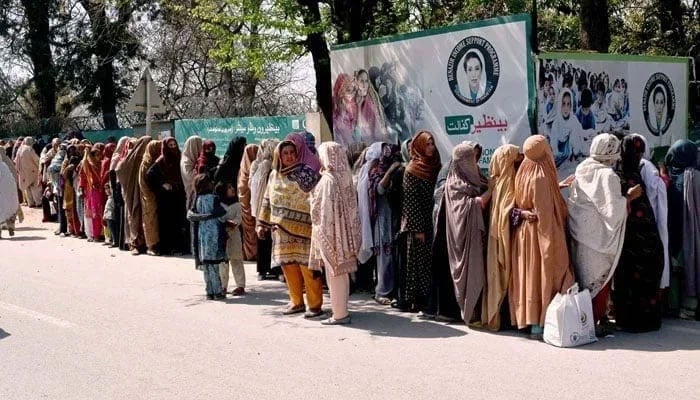
The Benazir Income Support Programme (BISP) was launched in 2008 as Pakistan’s flagship social safety net. BISP was created to protect the vulnerable – widows, mothers, children, households with no voice and no cushion. BISP was built in the name of the poor. BISP’s promise was simple: put cash in the hands of the poorest women in Pakistan.
Two questions now demand an honest answer. Has BISP remained a poverty-relief programme? Or has it become a politically branded cash machine? In 2019, more than 820,000 names were removed from BISP after NADRA profiling. Among them were government employees, spouses of government employees, vehicle owners, overseas travellers and higher-income individuals.
Eighteen years ago, BISP began as compassion. Unfortunately, BISP grew into politics.
Yes, the removal of 820,000 names should have shaken the state. Cold truth: It did not. BISP is now alleged to be becoming something worse: a vast welfare machine where the poor are the slogan, the taxpayer is the financier, the middleman is allegedly the beneficiary and accountability is an afterthought. Colder truth: Over the years, audit reports, verification exercises and investigation records have alleged a darker possibility: a programme built in the name of the poor may have become a feeding ground for the powerful, the connected and the undeserving. Here’s the pattern: weak beneficiary lists invite fraud. Cash through intermediaries invites deductions. Political control turns welfare into patronage. Audits after disbursement turn accountability into theatre.
Pakistan has built a welfare programme without building the governance architecture needed to protect it. To be certain, Pakistan needs a social safety net. To be sure, Pakistan does not need a safety net full of holes. Pakistan does not need cash transfers without verification. Pakistan does not need welfare captured by politics, intermediaries and fraud.
The BISP reform must be simple and strict. First, annual recertification through NADRA, FBR, vehicle, travel and government employment databases.
Second, direct digital payments into verified accounts -- no agent, no retailer, no middleman. Third, a public audit dashboard showing every rupee by district, category and grievance. Fourth, cash support must be linked to skills, school attendance, health checks and income generation. The goal must be relief today and exit from poverty tomorrow.
BISP must remain a shield for the poor. But a shield full of holes protects no one. Welfare must lift people out of poverty, not trap them inside a political economy of dependency.
Red alert: There is no greater betrayal than stealing from the poor in the name of the poor.