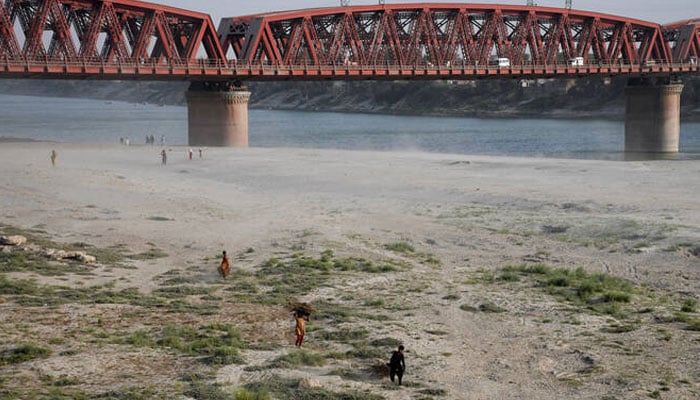
Walk the length of a distributary in southern Punjab in July. Watch what happens to the water between the mogha and the tail. By the time it reaches the last farm on the channel, if it reaches it at all, a substantial share has already disappeared: into cracked earthen banks, into silt-choked beds, into the ground. The tail-ender who was promised his rotation gets a trickle. The head-ender has long since taken his share and more.
Travel south to the Indus Delta. Where great channels once pushed freshwater into the sea, mangroves are retreating, fishing communities are abandoning their villages, and the ocean is moving inland. The delta is not dying from drought. It is dying from thirst imposed from upstream.
These are not two separate crises. They are the same crisis: a system that cannot deliver the water it already has. Yet our national conversation remains stubbornly fixed on storage. Build another reservoir. Construct another barrage. Increase headworks capacity. Storage has become our default answer to every hydrological anxiety.
It is the wrong answer. Pakistan diverts an enormous volume of water annually through the Indus Basin Irrigation System. Yet less than half of it reaches crops productively. More than half of the water diverted is lost to seepage, leakage, over-application and evaporation before it nourishes a plant. This is among the lowest irrigation efficiencies of any major system in the world. No reservoir, however large, can compensate for losses this catastrophic.
The losses concentrate at specific, unglamorous points. Main and secondary canals lose a significant share to seepage through deteriorated earthen banks before water even reaches the farm delivery network.
The catastrophic loss occurs further down, in the watercourses. These hundreds of thousands of kilometres of mostly earthen channels carry water from canal outlets to individual farms. They are the last mile of Pakistan’s irrigation system, and they are where the system most completely fails. In unlined watercourses, which remain prevalent across the system, most of the water that enters never reaches a farm gate. Even lined watercourses, where maintenance has been neglected, lose nearly half their flow because cracks, siltation and structural failure eventually defeat the original investment.
Then comes the field itself. Flood irrigation dominates. The warabandi system delivers water on fixed seven-day rotations regardless of soil moisture, rainfall or crop growth stage. Farmers receive water when the schedule says so, not when the crop needs it. To compensate, farmers have drilled over a million tubewells in Punjab alone and the number keeps rising. Most operate without meters or licenses. Water tables are falling across large parts of Punjab. In other areas, waterlogging and salinity are advancing, creating a second crisis to sustain the first.
No new dam addresses any of this. A reservoir adds capacity at the top of the system. It does nothing for the losses in unlined watercourses. It does not stop farmers from over-irrigating on fixed rotations. Storage is a supply-side answer to a demand-side catastrophe. Our political class understands this, but infrastructure is easier to announce than reform.
The case for efficiency is nonetheless compelling. A meaningful improvement in conveyance and on-farm water use, achievable with existing technologies and sustained maintenance, would conserve more water than the combined live storage capacity of all our reservoirs. Unlike a dam, efficiency gains begin immediately and reach the farmer directly.
But we must also ask where saved water would go. Without deliberate planning, efficiency gains risk being absorbed by expanded cultivation rather than redirected to stressed cities, industrial growth, or the dying ecosystems downstream. Seawater has already intruded deep inland along the Sindh coastline, destroying mangrove forests that buffered communities against cyclones, degrading farmland and displacing fishing families whose livelihoods depended on the brackish-water species the delta once sustained. Pakistan needs an integrated water accounting framework that tracks and allocates savings transparently across sectors, from the headworks to the delta. Otherwise, the crisis simply migrates from Punjab’s watercourses to Sindh’s coastline.
The external pressures on our water are real, and they compound the internal failures. Pakistan must defend its rights under the Indus Waters Treaty with full vigilance. But a country that loses more than half of what it diverts, extracts groundwater without licensing or measurement and allows its delta to wither for want of downstream flow speaks with diminished credibility in any international water forum. Internal discipline is not a distraction from external advocacy. It is its foundation.
Reform will not be easy, particularly for smallholder farmers with fewer than five acres who cannot absorb upfront costs or meet technology mandates. Any serious reform must be differentiated: support and subsidy for smaller farmers, metering and graduated tariffs for larger operations. Punitive reform will fail. But the absence of reform is also failing, silently, seasonally, at the tail-end of every distributary in the country and visibly in the encroaching saltwater of the delta.
Pakistan still possesses the alluvial plains, the canal network, the farming knowledge and the engineering capacity to turn this around. What it has consistently lacked is the political will to treat water as a resource requiring management rather than an entitlement requiring only distribution. We cannot store our way out of this crisis.
The writer is a former Punjab minister for irrigation and finance, with extensive experience in Pakistan’s provincial and federal legislatures.