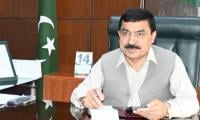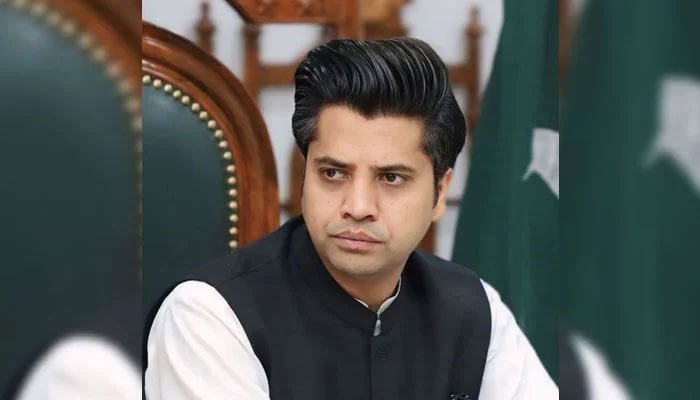
PESHAWAR: Khyber Pakhtunkhwa Minister for Information and Public Relations Shafiullah Jan on Friday held a detailed press conference outlining the provincial cabinet’s decisions, the law and order situation, and issues related to provincial rights.
He said Chief Minister Sohail Afridi had played an active role in opposing the suspension of CNG supply and restrictions on wheat transportation to Khyber Pakhtunkhwa, adding that he mobilised all political parties on a joint platform to address the issue.
The minister said KP produces 508 MMCFD of gas, while its domestic requirement stands at only 180 MMCFD. Despite constitutional provisions granting provinces the first right over their resources, he alleged that the province has historically faced discriminatory treatment from the federal government.
He added that power shortages and restrictions on wheat supply from Punjab had severely affected local industries and flour mills.
On security, Shafiullah Jan said certain districts were facing law and order challenges, which he attributed to decisions made in closed-door settings without broader consultation.
He said the provincial government was spending heavily on counter-terrorism and police modernization, describing security as a top priority alongside health and education.
For the current fiscal year, he said Rs170 billion had been allocated for police, amounting to 8.7 per cent of the provincial budget, the highest ratio among provinces. He compared this with Punjab’s 3.9 per cent and Sindh’s 5.9 per cent.
He added that police funding had increased by 37 per cent over the last two years, with an additional Rs46 billion allocated for modernization, including intelligence systems, weapons, technology, and training.
According to him, Rs17 billion is being spent on development of the security sector and over Rs18 billion on police salaries.
The minister criticized reductions in the federal share of the Accelerated Implementation Programme (AIP) for merged districts, stating that allocations had fallen from Rs42 billion to Rs37 billion, of which only Rs22 billion had been released.
He said the police-to-population ratio in the province stood at 1 officer for 291 citizens, and 3,550 new police posts had been created, including in merged districts.
The minister announced that Rs749 million had been released for 312 cases under the Shuhada compensation package. He also indicated plans to increase the police budget by 12 percent in the next fiscal year.
He said the 53rd cabinet meeting approved several major decisions, including the merger of the Levies Force into the police in Malakand Division and the introduction of a uniform police system there.
The cabinet also approved the Digital Transformation Policy and Roadmap 2030, aimed at modernising governance through digitisation, cybersecurity, digital payments, and the use of artificial intelligence and data analytics.
In agriculture, the cabinet approved the reconstitution of the Khyber Pakhtunkhwa Seed Council to ensure quality seed supply, improve research, and enhance food security.
In the health sector, approval was granted for the construction of women’s hostels and a multi-storey parking facility at the Peshawar Institute of Cardiology.
The cabinet also approved a transparent recruitment mechanism for Medical Teaching Institutions (MTIs), pending salaries for 906 health technicians and vaccinators, and a formal salary structure for contract employees.
Financial assistance worth Rs760 million was approved for nine patients requiring expensive medical treatment.
The cabinet approved a Rs2 million grant for the Youth Leaders Parliament and Rs9.982 million for the National T20 Cricket Cup 2025–26 held at the Imran Khan Cricket Stadium, Peshawar.
It also approved the procurement of 29 containerized office and residential units for deputy commissioners in Khyber and Kurram districts, along with the extension of service for assistant qazis in Malakand Division.