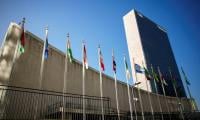
ISLAMABAD: Pakistan has formally accepted an invitation from US President Donald Trump to join the Board of Peace (BoP) with the view to achieving lasting peace in Gaza but made it clear that it was doing so under the framework of the United Nations.
Announcing this, the Foreign Office said, “In response to the invitation extended to Prime Minister Muhammad Shehbaz Sharif by the President of the United States, Donald J Trump, Pakistan would like to announce its decision to join the Board of Peace (BoP) as part of its ongoing efforts to support the implementation of the Gaza Peace Plan under the framework of the United Nations Security Council Resolution 2803”.
On Wednesday, the Foreign Office, while accepting the invitation, pointed out that Pakistan expresses the hope that with the creation of this framework, concrete steps will be taken towards the implementation of a permanent ceasefire, further scaling up of humanitarian aid for the Palestinians, as well as reconstruction of Gaza. “Pakistan also hopes that these efforts will lead to the realisation of the right to self-determination of the people of Palestine, through a credible, time-bound political process, consistent with international legitimacy and relevant UN resolutions, resulting in the establishment of an independent, sovereign and contiguous State of Palestine, based on the pre-1967 borders with Al-Quds Al-Sharif as its capital,” said the Foreign Office.
In this regard, Pakistan says it looks forward to continue playing a constructive role as part of the Board of Peace for the achievement of these goals as well as to end the suffering of our Palestinian brothers and sisters.
According to the Foreign Office, besides Pakistan, the Arab Republic of Egypt, the Hashemite Kingdom of Jordan, the United Arab Emirates, the Republic of Indonesia, the Republic of Türkiye, the Kingdom of Saudi Arabia and the State of Qatar welcomed the invitation extended to their leaders by the President of the United States of America, Donald J. Trump, to join the Board of Peace.
Ishaq Dar, Foreign Minister and Deputy Prime Minster on his X platform said, “Group of Eight Arab-Islamic countries jointly announce their decision to join the Board of Peace (BoP). Pakistan has been and will continue to work with our brotherly Arab-Islamic countries for lasting peace in Gaza and for ensuring the right to self determination of our Palestinian brothers and sisters.”
Meanwhile, US President Donald Trump is set to formally announce the first charter of his “Board of Peace”, a body for resolving international conflicts with a $1-billion price tag for permanent membership. The board, which Trump will launch with what has been billed as a signing ceremony in Davos, Switzerland on Thursday, was originally conceived to oversee the rebuilding of Gaza. But a draft of the charter seen by AFP does not appear to limit its role to the Palestinian territory. The Board of Peace will be chaired by Trump, according to its founding charter sent to countries invited to participate. It is “an international organisation that seeks to promote stability, restore dependable and lawful governance, and secure enduring peace in areas affected or threatened by conflict”, reads its preamble. It will “undertake such peace-building functions in accordance with international law”, it adds. Trump will be chairman but also “separately serve” as representative of the United States. “The chairman shall have exclusive authority to create, modify or dissolve subsidiary entities as necessary or appropriate to fulfil the Board of Peace´s mission,” the document states.
He will pick members of an executive board to be “leaders of global stature” to “serve two-year terms, subject to removal by the chairman”. The charter says the chairman can be replaced only in case of “voluntary resignation or as a result of incapacity”. A US official confirmed that Trump could keep the chairmanship, even after leaving the White House, “until he resigns it”, although a future US president can appoint a different US representative.
Some 35 world leaders out of 50 or so invited have agreed to join the board so far, a senior White House official told reporters Wednesday.
Meanwhile, Prime Minister Shehbaz Sharif said Pakistan’s economy was showing clear signs of improvement and the country was moving forward with renewed confidence, as key economic indicators continued to strengthen.
Addressing an event at the Pakistan Pavilion on the sidelines of the 56th Annual Meetings of the World Economic Forum, the prime minister said Pakistan had achieved macroeconomic stability after difficult but necessary reforms and was now firmly focused on export-led growth and sustainable development. “Our inflation has come down sharply from 30 percent to 5.5 percent, while the policy rate has been reduced from 22.5 percent to 10.5 percent,” he said, adding that the improvement reflected disciplined economic management. He noted that Pakistan’s IT exports had shown reassuring progress and now stood at around $3 billion annually through offshore channels.
On foreign relations, he said Pakistan enjoyed strong economic ties with China and was building cooperation with the United States, particularly in mining, minerals, counterterrorism and technology.
Referring to the IMF programme, he said Pakistan had adhered to stringent conditions in letter and spirit, adding that the Fund was now citing Pakistan as a success story for developing countries. As regards structural reforms, the prime minister said the government had taken tough decisions to shut down loss-making and inefficient state entities.
Meanwhile, Prime Minister Shehbaz Sharif apprised Managing Director of the International Monetary Fund (IMF) Kristalina Georgieva of Pakistan’s improving macro-economic indicators, stabilisation efforts, and progress on structural reforms. He underscored Pakistan’s commitment to fiscal discipline, revenue mobilisation and sustainable growth.
The prime minister met the IMF MD in Davos, Switzerland, on the sidelines of the 56th annual meeting of the World Economic Forum, the PM Office Media Wing said in a press release.
The IMF managing director acknowledged and appreciated Pakistan’s reform efforts and emphasised the importance of maintaining reform momentum to ensure long-term economic resilience. Both sides exchanged views on the global economic outlook, challenges faced by emerging economies and the importance of multilateral support in safeguarding economic stability.
Reuters says Pakistan hoped “concrete steps will be taken towards the implementation of a permanent ceasefire” as well as to boost aid and Gaza’s reconstruction, the ministry said in a statement. The announcement came after Pakistani army chief Field Marshal Asim Munir flew to Davos, three Pakistani officials told Reuters.
Meanwhile, Leader of Opposition in the Senate Senator Allama Nasir Abbas denounced the government’s decision to join the President Donald Trump’s Board of Peace, calling it morally incorrect and indefensible both on principle and policy, which will dilute its moral standing.
In his strong reaction to the development, Senator Nasir, who is also the chairman of Majlis Wahdatul Muslimeen, claimed that the initiative was problematic from the outset and that Pakistan will regret the decision. He warned that by associating itself with a project that undermines both Palestinian agency and the UN system, Pakistan risks diluting its moral standing and strategic coherence. “What makes Pakistan’s participation more troubling is that an initiative sold at the start, as a limited mechanism for rebuilding after the genocide in Gaza, is now being openly expanded. Statements by its principal sponsor and the contents of its draft charter suggest ambitions well beyond Palestine, with little regard for the United Nations,” he pointed out. The absence of clear UN oversight and the board’s widening mandate, he emphasized, point towards an attempt to supplant, or at the very least marginalise, the existing multilateral system. “By lending its name to this effort, Pakistan appears to endorse a structure that sidelines the UN and replaces international law with a personalised political platform. This sits uneasily with Islamabad’s own reliance on multilateral forums and UN resolutions, particularly on issues such as Kashmir, where Pakistan consistently argues for the primacy of international legality,” he contended.